A caller in Lagos dials a healthcare hotline at 7:42 on a Monday morning. The phone rings once. Somewhere in an AWS region eight hundred milliseconds away, a contact flow wakes, a Lex bot listens for an intent, a Bedrock Knowledge Base retrieves a chunk of policy, an agent reasons over it, and a synthesised voice begins to speak. The whole choreography unfolds in under one and a half seconds. The caller does not notice the choreography. That is the point.
Eighteen months ago, a generative-AI contact-centre brief looked like a chatbot proof-of-concept. Today the same brief looks like a production architecture problem. The model is no longer the interesting question — Claude Sonnet, Nova Pro, or Mistral Large will all hold an adequate conversation about a refund policy. The interesting questions sit around the model. How fast does the first word reach the caller. How reliably does the agent identify when it cannot help. How does the supervisor pick up a call mid-stream with full context. What does it cost per minute at the volumes a real contact centre runs.
Key takeaways
- The production architecture is a five-stage pipeline — Connect contact flow, Lex for intent and slot capture, Bedrock Knowledge Bases for retrieval, a Bedrock Agent for action-taking, Polly Neural or a Bedrock voice model for response — with a deterministic supervisor handoff at the end of every path.
- End-to-end latency target is 1.2-1.6 seconds from end-of-user-utterance to first audible response token. Streaming TTS, prompt caching, and warm Lambda paths are what make this hit; buffered TTS makes it unusable.
- Lex and Bedrock compose, not compete. Lex captures structured slots deterministically; Bedrock reasons over the unstructured remainder. Slot validation against business rules happens before Bedrock is invoked, not after.
- A 4-minute fully-automated call lands around $0.18-0.32 fully loaded; the same call escalated to a human at minute three is 3-4x that figure once agent time is priced in. Automation rate is the unit-economics lever.
- The pattern breaks on long calls (context bloat past 12 turns), on dialect coverage outside North American English (Nigerian, Indian, Latin American Spanish need explicit ASR tuning), and on supervisor handoff if transcript, intent stack, and KB citations aren't passed across cleanly.
The five-stage relay
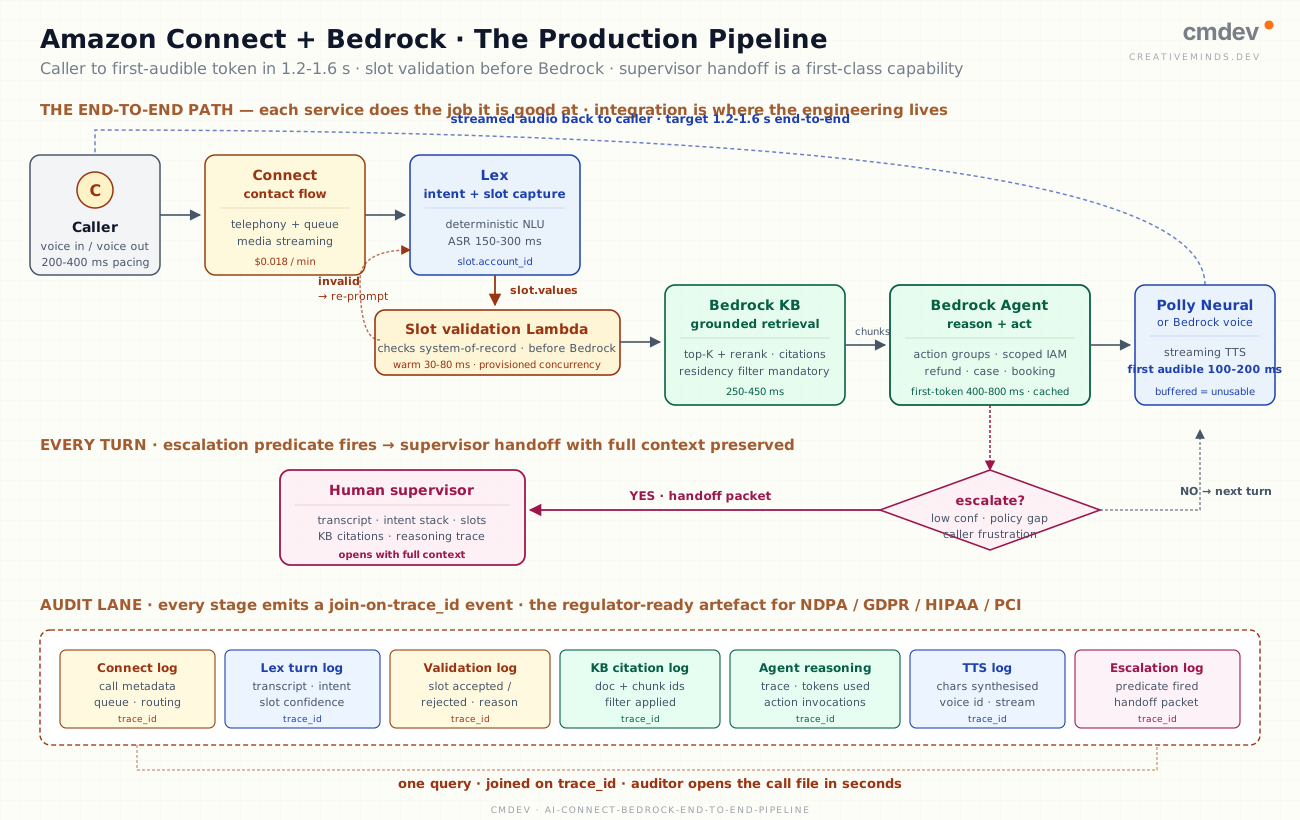
The architecture that wins is reasonably stable now. Think of it as a relay race in five legs. Connect handles telephony, IVR, queueing, and routing — the stadium and the track. Lex handles intent detection and structured slot capture — the first runner, fast and disciplined, never improvising. Bedrock Knowledge Bases handle grounded retrieval — the runner who reads the playbook before passing the baton. A Bedrock Agent handles action-taking under explicit permissions — the runner who actually does something with what the previous two collected. Polly Neural, or increasingly Bedrock-hosted voice models, handles text-to-speech — the runner who carries the result across the finish line so the caller hears it. Each leg has one job. The integration between them is where the engineering work lives.
The flow, in order: a caller dials in and Connect picks up. The contact flow invokes Lex for intent detection and slot capture. Captured slots — account number, claim ID, date range — are validated against the system of record through Lambda before Bedrock is invoked. A wrong account number means a re-prompt, not a Bedrock call. With validated slots in hand, the Knowledge Base returns the top-K chunks with citations and metadata. The Bedrock Agent reasons over retrieved chunks plus conversation state and decides whether to respond, invoke an action group like processing a refund or opening a case, or escalate. Agent text streams back through Polly Neural or a Bedrock voice model. And every turn checks an escalation predicate — if it fires, the call hands off to a human supervisor with full transcript, intent stack, KB citations, and reasoning trace.
The composition is what matters. Lex without Bedrock cannot handle the unstructured request — "I changed jobs last month and I'm not sure my dependants are still covered." Bedrock without Lex cannot reliably capture the structured part — "my member ID is 8847-2261-0034" — at the precision downstream systems require. Together they cover the request surface a competent human agent would, with a deterministic escalation path for the rest.
Tending the corpus, not just the model
Retrieval separates a contact-centre agent that grounds its answers from one that hallucinates policy. Four things matter, and corpus hygiene is the one most teams underspend on.
A contact-centre corpus is policy documents, procedure manuals, FAQs, scripts, call-handling guides — half of it out of date on any given day. The first move on every engagement is a corpus audit. If the 2024 and 2026 refund policies both sit in the bucket with no distinguishing metadata, the agent quotes whichever ranks higher on cosine similarity. That is a corpus problem, not a model problem — the librarian failed before the reader walked in.
Chunking for conversational retrieval is tighter than for document Q&A. Smaller chunks of 200 to 300 tokens, with tighter top-K of three to five after re-ranking, keep retrieval and synthesis inside the 1.2-second envelope. Hierarchical chunking is right for long policy documents — small leaf chunks for precision, parent chunks returned for context.
Sensitivity classification belongs at ingestion, not retrieval. Each document carries a metadata sidecar with classification — public, customer-visible, internal-only — and residency — EU, Nigeria, UK, US. Retrieval calls are issued with mandatory filters, enforced at the API layer, not the prompt layer. NDPA and GDPR compliance ride on this being non-negotiable.
Re-ranking is on for production. The 10–30% precision gain Cohere Rerank delivers on hard queries is worth the 80–150ms latency wherever wrong answers carry real consequence. The exception is FAQ-lookup where retrieval is already near-perfect. The deeper RAG playbook lives in RAG with Bedrock Knowledge Bases; the contact-centre additions are the residency filter, the smaller chunk size, and the corpus audit as a precondition.
Voice is a real-time systems problem
Voice is where the pattern stops being a chat application and becomes a real-time systems problem. AWS publishes a reference implementation at aws-samples/sample-amazon-connect-bedrock-agent-voice-integration — Connect media streaming into a Lambda that calls a Bedrock Agent and streams the response through Polly. Read the code, then engineer around its assumptions.
Natural conversational pacing is 200 to 400ms between turns. Beyond 800ms callers ask "hello?" Beyond 1.5 seconds they assume the system has failed. The end-to-end budget from end-of-user-utterance to first audible response token reads like a relay's split times.
| Stage | Latency | Notes |
|---|---|---|
| ASR transcription (Connect → Lex) | 150-300ms | Streaming partial results; Lex native |
| Slot validation Lambda | 30-80ms warm / 800-1500ms cold | Provisioned concurrency mandatory |
| KB retrieval (embedding + search + rerank) | 250-450ms | Re-ranking is the biggest contributor |
| Bedrock Agent reasoning (first token) | 400-800ms | Prompt caching cuts this 30-50% on later turns |
| TTS synthesis (first audible, streaming) | 100-200ms | Polly Neural streaming |
| End-to-end target | 1.2-1.6 seconds | Without streaming, 2.5-3.5 sec — unusable |
The single most important architectural decision is streaming versus buffered TTS. Buffered synthesises the whole response then plays it — like a chef who refuses to send the appetiser until the entire tasting menu is plated. Streaming receives tokens as they arrive and plays the first segment while later ones generate — the appetiser arrives while the main is still on the grill. Polly Neural supports streaming through Connect's media streaming API; Bedrock voice models support it through InvokeModelWithResponseStream. Use streaming. The difference between 600ms first-audible-token and 1.8 seconds is the difference between a usable voice agent and an unusable one.
Polly Neural is the default — AWS-native, lowest latency, strong English coverage for US, UK, and Australia, well-priced at $16 per million characters. Right wherever conversational pacing matters more than vocal warmth. A Bedrock voice model wins where vocal warmth and prosody carry signal — premium experiences, healthcare, wealth management — or where Polly's language coverage is weak. The trade-off is two-to-four times the per-character cost and 50 to 100ms longer first-token latency.
ASR is where dialect issues bite hardest. Connect ships strong North American English and serviceable Standard British English. Nigerian English, Indian English, Caribbean English, and the various Spanish dialects need explicit ASR profile tuning, or a third-party layer like Deepgram or Speechmatics substituted in front of Lex. The failure mode is silent — transcription returns plausible-but-wrong text, slot capture fires on the wrong value, the agent confidently misunderstands. Catching this requires sampled audio review against the transcript. It will not surface in a dashboard.
A traffic cop with two specialists
The framing "Lex or Bedrock" misreads what each does. Lex converts an utterance into a structured intent with deterministic slot capture against a defined schema — it is not good at open-ended reasoning. Bedrock reasons over retrieved context — it is not good at deterministic slot capture against a strict schema. Asking either one to do the other's job is like asking a court stenographer to deliver the closing argument.
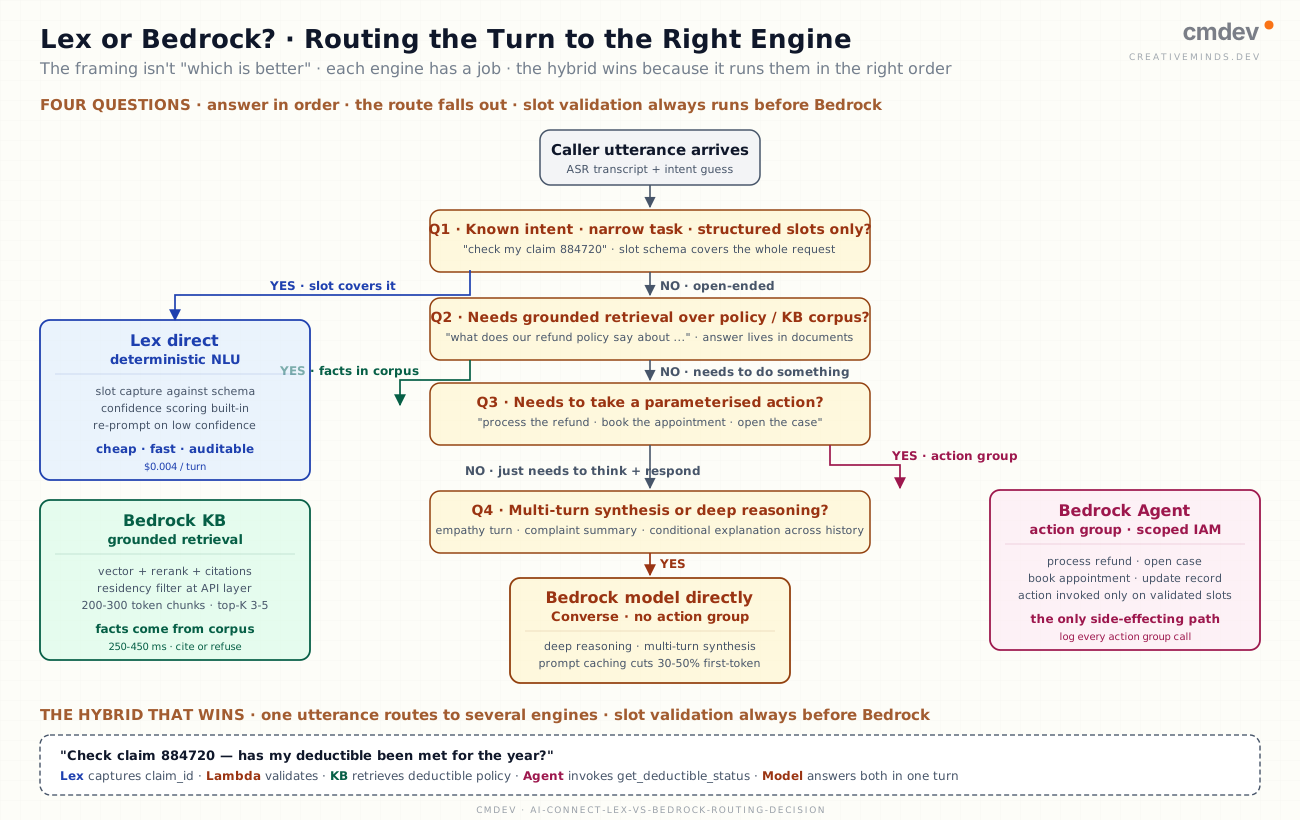
The hybrid is the production pattern. Lex captures slots through deterministic NLU; slots are validated against business rules and the system of record; only then does the Bedrock Agent run, with both the slot values and the unstructured remainder as inputs.
A claim-status call illustrates. Caller: "Check claim 884720, and tell me if my deductible has been met for the year." Lex extracts check_claim_status with claim_id: 884720 — the structured part. The deductible question is the unstructured remainder. A validation Lambda confirms the claim. KB retrieval runs with residency and product-line filters. The Bedrock Agent answers both in one turn. Bedrock-only would fail the slot capture — "884720" gets coerced wrong, the policy system rejects, three extra turns happen, the caller hangs up. Lex-only would capture the ID cleanly but have no path to the deductible question; everything escalates. The hybrid runs both, and slot validation before Bedrock is invoked is the single most important rule.
Four numbers that say "good"
Voice evaluation is harder than chat evaluation because the audio adds a layer the model never sees. Four metrics matter, tracked separately, like the four vital signs on a hospital bedside monitor.
Transcript quality — Word Error Rate against sampled human re-transcription. Sub-8% for North American English, sub-12% for Indian English, sub-15% for Nigerian English are realistic working bars. Bad transcripts produce confident-but-wrong intent capture; fixing this upstream is cheaper than every downstream fix.
Intent and slot accuracy — above 92% intent and 95% slot is achievable on a well-tuned bot. Below 85%, the agent feels broken regardless of downstream reasoning quality.
Escalation correctness — escalating when the agent could have handled it inflates per-call cost; failing to escalate when it cannot help produces a repeat call. Precision and recall both above 90% against a sampled-review rubric.
Audit trail completeness — transcript, intent stack, slot values, KB citations, reasoning trace, action group invocations, escalation decision and reason. The regulatory artefact for NDPA, GDPR, HIPAA, or PCI workloads; designing it as an afterthought is the most expensive mistake we see.
The harness runs continuously — a 1–3% sample of production calls routes through human review, trendlines publish, regressions alert. Without this loop, every model update, KB ingestion, or Lex retrain ships blind.
What a four-minute call actually costs
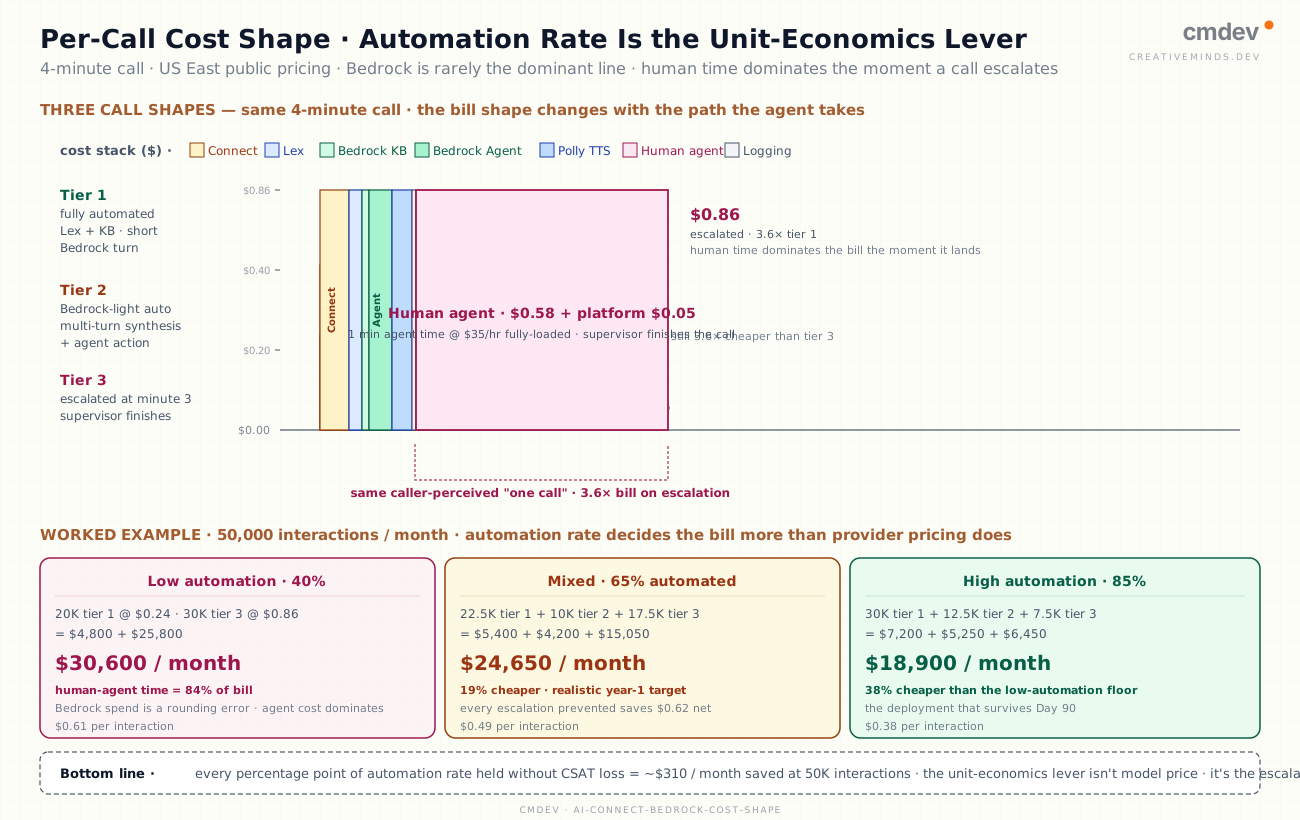
The cost surface combines per-minute Connect and Lex pricing with per-token Bedrock pricing. Modelling it as "Bedrock plus small Connect overhead" understates the real bill — it is more like running a restaurant where the wine, the staff, and the rent are each a different shape of expense and you cannot price the meal by looking at the ingredients alone.
A four-minute fully-automated call in US East at current public pricing:
| Component | Cost |
|---|---|
| Connect voice ($0.018/min × 4 min) | $0.072 |
| Lex voice requests ($0.0040 × 8 turns) | $0.032 |
| KB retrieval + Cohere Rerank (8 queries) | $0.017 |
| Bedrock Agent input — Claude Sonnet (~22K tokens, with prompt caching) | $0.005 |
| Bedrock Agent output (~3.5K tokens) | $0.053 |
| Polly Neural TTS streaming (~3,200 chars) | $0.051 |
| Connect logging + CloudWatch | $0.010 |
| Total | ~$0.24 |
The same call escalated at minute three adds Connect agent time — one minute at a fully-loaded $35 an hour, roughly $0.58 — plus a platform fee of around $0.05. Total: roughly $0.86, with agent time dominating the bill the way labour dominates the cost of a sit-down meal once the chef has plated the dish.
Every percentage point of automation rate the agent can hold without sacrificing CSAT translates to a meaningful unit-economics improvement at contact-centre volumes. The structural point: Bedrock is rarely the dominant line on a fully-automated call. Connect, TTS, and Lex usually are. Human time dominates the moment a call escalates.
Five places the pattern bends
Five failure modes worth knowing before they bite.
Long calls produce context bloat. Past about twelve turns, conversation history competes with retrieved context for the model's attention. The fix is explicit summarisation at turn eight — replace verbatim history with a structured summary of intent stack, slots, prior responses, and outstanding questions; reason over the summary plus the last two turns.
Multi-turn intent switches catch most teams off guard. "Actually, forget the claim, I need to update my address." Lex tracks the current intent but not the implicit switch. Bedrock keeps reasoning about the claim. The fix is a per-turn intent-switch detector on Haiku or Mistral that classifies whether the latest utterance maintains, refines, or replaces the active intent.
Dialect and accent coverage is where the failure is silent and expensive. The Nigerian English caller whose claim ID transcribes with a trailing zero elided produces a valid-looking wrong number. The Mumbai English caller whose "1A8" becomes a 1 plus a stray letter. The fix is per-dialect ASR profiles where Connect supports them, sampled audio review, and slot validation that rejects implausible values rather than passing them downstream.
Supervisor handoff is the single most expensive UX failure in any contact-centre AI deployment. Caller escalated, human picks up, caller asked to repeat everything. The fix is to engineer the handoff packet — transcript, intent stack, slots, KB citations, reasoning trace, escalation reason — rendered on the supervisor's screen at call pickup, so the supervisor opens the conversation with full context already in hand. Like a relay runner who arrives at the baton zone already in motion.
Knowledge Base drift is the slow leak. Policy update lands in the bucket. KB hasn't re-ingested. The agent quotes the old policy. The fix is scheduled re-ingestion — daily for active corpora, hourly for high-change content — change-detection sync, freshness metadata as a default filter, in place before the first policy update, not after the first complaint.
The handoff that decides everything
The pattern works because each service does the job it is good at. The engineering is in the integration — slot validation before Bedrock, mandatory metadata filters at retrieval, streaming TTS end to end, the evaluation harness running continuously, and a supervisor handoff engineered for the moment the agent reaches its limit.
That last point is what separates the deployments that survive day ninety from those that do not. An agent that escalates cleanly with full context preserved is the agent customers tolerate when it cannot help. One that does not erodes trust call by call until the project gets shut down. The question worth carrying out of this piece is shorter than the pipeline: when your agent runs out of road, does the human picking up the baton already know where the conversation has been?
FAQs
Why use Lex at all if Bedrock can hold a conversation?
Different jobs. Lex captures structured slots (account numbers, claim IDs, dates) with deterministic confidence scoring against a defined schema — exactly where Bedrock is weakest. Bedrock reasons over unstructured context — exactly where Lex has no path. The hybrid runs Lex first to capture and validate slots against business rules, then runs Bedrock with the validated structured inputs plus the unstructured remainder. Slot validation before Bedrock is invoked prevents Bedrock burning tokens on inputs the downstream systems will reject.
What end-to-end latency is achievable?
1.2-1.6 seconds from end-of-user-utterance to first audible response token in a well-engineered deployment — streaming TTS, prompt caching, warm Lambda paths, re-ranking on. Without streaming TTS, the number is 2.5-3.5 seconds and the agent feels broken. The biggest contributor is Bedrock Agent first-token time (400-800ms); prompt caching cuts this 30-50% on multi-turn conversations.
Polly Neural or a Bedrock voice model?
Polly Neural is the default — AWS-native, lowest latency, strong English coverage, well-priced. A Bedrock voice model wins where vocal warmth and prosody carry signal (premium experiences, healthcare, wealth management) or where the language isn't well-supported by Polly. The trade-off is 2-4x per-character cost and 50-100ms additional first-token latency.
How do we keep data inside the right residency boundary?
Mandatory metadata filters at retrieval, enforced at the API layer not the prompt layer. Each KB document carries a residency tag at ingestion. Every retrieval call is issued with `residency = caller_residency` plus a classification filter; the retrieval API rejects calls missing these filters. NDPA and GDPR compliance ride on this.
What does the supervisor handoff actually contain?
A structured packet — transcript, intent stack, captured slot values, KB citations, reasoning trace, escalation reason — rendered on the supervisor's screen at call pickup. The supervisor opens with full context. Done improperly (caller asked to repeat everything) is the single most expensive UX failure in any contact-centre AI deployment.
Companion content
- RAG with Bedrock Knowledge Bases: From S3 to Vector Retrieval
- Multi-Model AI on Amazon Bedrock: How We Deploy the Right Model for Every Task
- Cost Optimisation on Amazon Bedrock
- Cold-Start Latency and Cost for Multimodal RAG Pipelines
- Security Guardrails and Observability for Bedrock
How to engage
We design, ship, and operate AI-powered contact-centre architectures on Amazon Connect and Bedrock — latency-engineered, residency-aware, evaluation-instrumented, and built around supervisor handoff as a first-class capability. Talk to us at creativeminds.dev/contact.