A demo room at re:Invent, somewhere in late 2025. The solutions architect builds a working voice agent on stage in twenty-three minutes. The audience claps. Three months later, a procurement officer at a Lagos-based bank watches a recording of that demo, signs the engagement, and asks her engineering team how long until go-live. Six weeks, they say. The demo did the hard part. They are right about the demo. They are wrong about which part was the hard part.
AWS shipped Amazon Connect AI Agent as a managed agent inside Connect — a voice and chat agent you configure rather than build, that plugs into existing contact flows, hooks into a Bedrock knowledge base, and handles intent routing without you writing the underlying loop. The launch framing was that customers can stand up a working AI agent in days rather than the months a custom Bedrock Agent stack typically takes. For commodity contact-centre workloads — password resets, balance enquiries, order status, appointment scheduling — that framing is approximately correct.
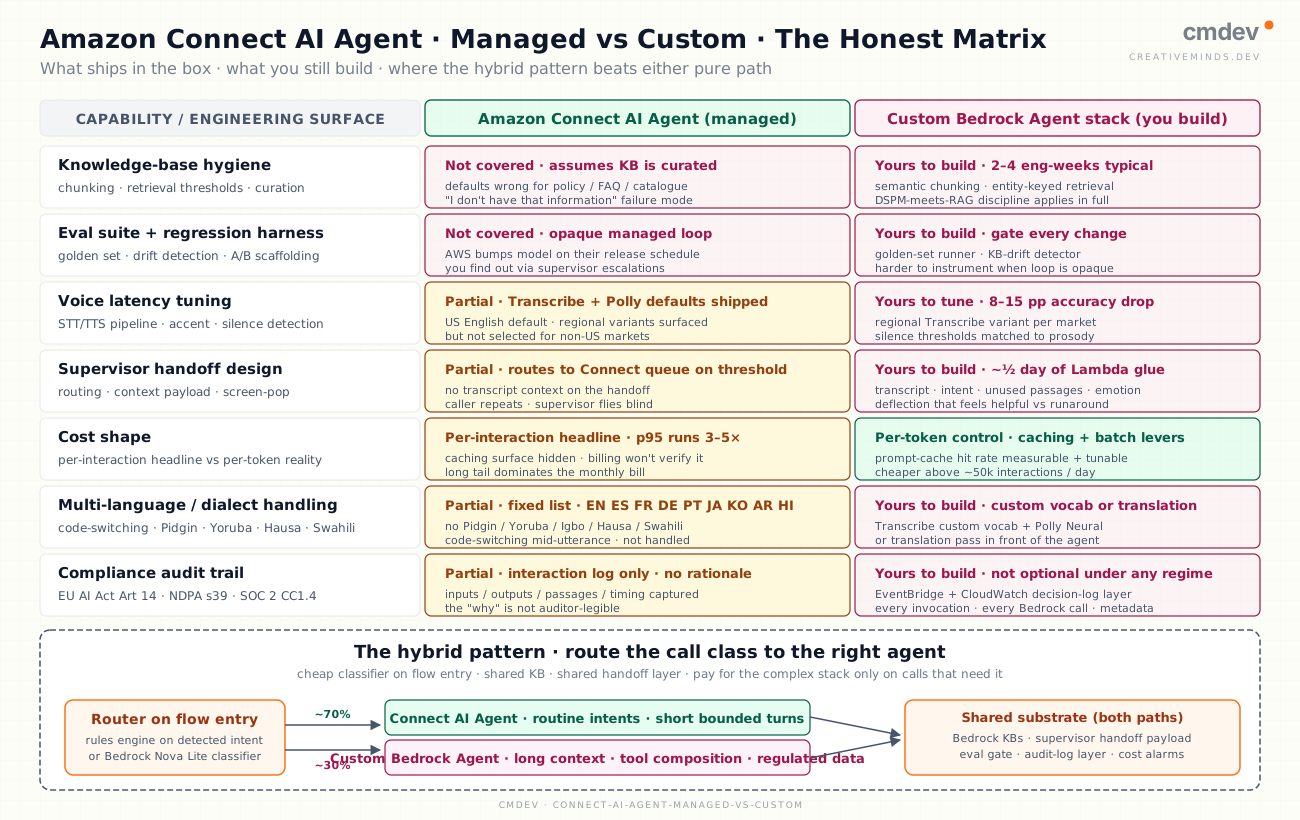
The reading gets sharper when you cost out a production rollout against a regulated buyer with a real call volume. The managed service covers the parts of the agent stack that are well-understood and worth outsourcing. It does not cover the parts that determine whether the agent actually works for your callers — knowledge-base hygiene, the eval suite, latency tuning across regional accents, supervisor handoff, the cost model under real interaction patterns, multi-language handling, and the audit trail your compliance team will ask about under Article 14 of the EU AI Act, NDPA Section 39, or SOC 2 CC1.4.
This piece is the honest engineering read on what Amazon Connect AI Agent saves you, what you still own, and the decision rubric for when the managed service is enough versus when you need a custom Bedrock Agent stack underneath it.
Key takeaways
- Amazon Connect AI Agent covers provisioning, the agent loop, intent routing, contact-flow integration, and the Bedrock knowledge-base hookup — roughly four to six weeks of work the managed service eats for you on the boring-but-load-bearing infrastructure layer.
- Seven things the managed service does not cover, in order of how often they bite in production: knowledge-base hygiene, the eval suite, voice latency across regional accents, supervisor handoff design, the per-interaction cost surprise, multi-language and dialect handling, and the compliance audit trail.
- The cost model in the launch deck is per-interaction; the cost model your finance team will care about is per-token under real conversation patterns — interactions that escalate or loop will run two to five times the headline rate, and that variance dominates the monthly bill.
- The hybrid pattern that works: Connect AI Agent for the seventy percent of routine intents, a custom Bedrock Agent stack for the thirty percent that need long context, tool composition, or regulated-data handling — with a router on the front end deciding which one takes the call.
- The managed agent is a substrate, not the destination architecture — the knowledge base, the eval gate, the handoff policy, and the audit log are still your engineering problem and live outside the managed service.
The kit car you assemble, not the engine you forge
The managed service is a Connect-native agent that sits inside the existing contact-flow editor. You configure an agent persona, attach one or more Bedrock knowledge bases, define the intents the agent should handle, set escalation rules, and drop the agent into a contact flow as a block. The underlying agent loop, the Bedrock model selection, the speech pipelines, and the knowledge-base retrieval are managed by AWS. The configuration surface is closer to setting up a Connect routing profile than to building a Bedrock Agent from scratch.
What this saves a team is real. Wiring a Bedrock Agent into Connect contact flows, handling the speech pipelines, implementing barge-in, tuning silence-detection thresholds, building the Connect-side observability so supervisors can monitor live calls — that is a four-to-six week effort on a custom stack. The managed service eats it. For a team without deep Connect experience, that is the load-bearing argument for the managed option. Think of it as a kit car. The engine, the drivetrain, the dashboard are pre-fabricated. You bolt the body on. You do not forge the cylinder block.
The architecture is honestly opinionated. AWS chose specific defaults for the model tier (a Bedrock-managed Claude or Nova depending on the workload), the retrieval pattern (Bedrock Knowledge Bases with hybrid search), the speech pipeline (Polly and Transcribe), and the contact-flow integration shape (a single block per agent turn). These defaults are reasonable. They are also non-negotiable in v1 — no escape hatch to swap the model, the retriever, or the speech engine without dropping back to a custom Bedrock Agent. Speed at the cost of architectural flexibility. For workloads where the defaults are correct, the speed is decisive. For workloads where the defaults are wrong, the managed service is a dead end and you should build the custom stack from day one.
The seven gaps the demo never shows
In order of how often they bite teams in production.
The first is knowledge-base hygiene. The managed agent assumes your Bedrock knowledge base is well-curated. It isn't. The default chunking strategy is wrong for most document types — policy documents need semantic chunking, FAQs need question-aligned chunking, product catalogues need entity-keyed retrieval. The default retrieval threshold is set high enough that the agent will frequently respond "I don't have that information" to questions whose answers are three retrieval hops away from where it looked. The DSPM-meets-RAG and RBAC for enterprise knowledge bases discipline applies in full, and the managed service does not absolve you of it. Budget two to four engineering-weeks of knowledge-base work for a typical rollout.
The second is the eval suite and regression harness. The managed service ships an interaction log and a Connect dashboard. It does not ship a golden-set runner, a regression harness, A/B scaffolding for prompt changes, or drift detection on knowledge-base updates. The managed service updates the underlying model and the agent loop on AWS's release schedule, not yours — a Bedrock model bump or a Connect flow update can shift behaviour, and without an eval suite you find out from a supervisor escalation queue rather than from change-management. Imagine running a kitchen where the supplier silently swaps your flour brand every few weeks and you only discover the change when a customer sends back a cake. The custom evaluation frameworks discipline applies in full; the managed loop is opaque, which makes the eval gate harder to instrument, not less necessary.
The third is voice latency tuning across regional accents. The managed pipeline uses Transcribe for STT and Polly for TTS. Both have known accuracy gaps on West African English, Indian English, Scottish English, and Caribbean English at production-quality thresholds. The default Transcribe model is American English. Regional variants exist but are not selected automatically. On a Nigerian deployment, intent classification accuracy drops eight to fifteen percentage points on caller turns with strong regional accents, and the supervisor-handoff rate rises with it. The fix is configuring the correct regional Transcribe variant and tuning silence-detection thresholds for the accent's prosodic pattern — both surfaced as configuration, neither set correctly by default for non-American markets. The highest-leverage tuning a pan-African rollout will do.
The fourth is supervisor handoff design. The default handoff routes to the existing Connect queue when confidence falls below threshold or the caller asks for a human. Correct in shape, inadequate in detail. The handoff carries no transcript context by default. The caller has to repeat the problem. The supervisor has no view of what the AI attempted, why it failed, or what the caller seemed to actually want — the data is in the Connect interaction log, not in the supervisor's screen-pop. The handoff feels like being transferred between airline counters and starting the conversation over with each agent. The work you still own is the handoff payload — transcript snippet, detected intent, retrieved-but-unused passages, emotion signal. Half a day of Lambda glue between Connect AI Agent and your CRM, and the difference between AI deflection that feels helpful and AI deflection that feels like a runaround.
The fifth is the cost surprise pattern. The launch deck prices the managed agent per-interaction. The actual cost shape on production is per-token, with two complications. First, an "interaction" is not a fixed-cost unit — interactions that escalate, loop, retrieve multiple times, or hand off and return all consume more tokens than the headline implies. We have seen workloads where the median sits at the headline rate and the 95th-percentile runs three to five times that, with the long tail dominating the monthly bill. Same shape as the agentic-loop cost pattern. Second, the managed agent's prompt-caching behaviour is not exposed to you, and the billing surface gives no way to verify caching is happening. For workloads above fifty thousand interactions a day, the gap between caching and not caching is large enough that you want the lever, and the managed service does not give it to you. Model the cost per-token using published Bedrock rates and a measured token distribution from a pilot, set a monthly cost-anomaly alarm on the line item, budget for the tail.
The sixth is multi-language and dialect handling. The managed service supports a fixed list of languages — English, Spanish, French, German, Portuguese, Japanese, Korean, Arabic, Hindi, and a handful more. Good but rigid. Pidgin English, Yoruba, Igbo, Hausa, Swahili, Wolof — none of these are supported. For a Nigerian rollout, code-switching between English and Pidgin in a single utterance is the modal caller pattern, and the managed agent does not handle it cleanly. The escape hatch is a custom Bedrock Agent stack with a Polly Neural voice and a Transcribe custom vocabulary, or a translation pass in front — neither of which is what the launch deck implies.
The seventh is the compliance audit trail. The Connect interaction log captures transcript, intent, response, retrieved passages, and timing. Sufficient for operations, not for a regulated-buyer audit under Article 14 of the EU AI Act, NDPA Section 39, or SOC 2 CC1.4. The gap is the decision rationale — why the agent routed this caller to a human, why it surfaced this passage and not that one, why it didn't detect the request. The managed agent does not log the model's reasoning chain in an auditor-legible way. You can get inputs and outputs; you cannot get the why. The work you still own is the audit-log layer — EventBridge-and-CloudWatch glue capturing every Connect AI Agent invocation and every Bedrock model call with the metadata that lets an auditor reconstruct a flagged call. Not optional under any of the three regimes.
Three workloads, three answers
The honest decision is workload-shape-first, not vendor-preference-first.
The managed service is enough when your volume is dominated by short, well-bounded intents — password resets, balance enquiries, order status, appointment scheduling. Your knowledge base is single-product or low-complexity. Your callers speak one of the supported languages without heavy regional accent variance. Your compliance regime is light or already-instrumented elsewhere. Your engineering team is closer to Connect-fluent than to Bedrock-Agent-fluent. In that intersection — most consumer-facing contact centres in tier-1 markets — the managed service is the right answer and the speed advantage is decisive.
You need a custom Bedrock Agent stack when callers need multi-step reasoning across multiple tools — CRM, billing, a third-party identity-verification API, knowledge base, transcript search — composed inside a single conversation turn. Your knowledge base is multi-product, multi-jurisdiction, or needs fine-grained access controls requiring strict RBAC. Compliance requires the decision-rationale log the managed service does not produce. Callers code-switch between languages the managed service does not support. Your cost model needs the prompt-caching and batch-tier levers the managed service hides. In that intersection, the managed service is a dead-end migration and you should build the custom stack from day one — building AI agents on Amazon Bedrock foundations is the right starting point.
For mid-complexity contact-centre workloads, the deployment shape we have converged on is a hybrid: managed Connect AI Agent for the routine seventy per cent, a custom Bedrock Agent stack on the same contact flow for the complex thirty per cent, with a router on the front end. The router is a small classifier — a rules engine over the intent detected at flow entry, or a Bedrock Nova Lite call that classifies the caller's opening utterance into routine or complex. Both paths share the same Bedrock knowledge bases and the same supervisor handoff layer. Same architectural pattern as Claude-first multi-model routing — match the right tier of agent to the right tier of call. The express checkout takes the customer with one item. The full-service counter handles the one paying in three currencies. Both share the same shelves.
What is worth waiting for, and what is not
AWS will close some of these gaps on the published roadmap — better multi-language coverage, more flexible model selection, plausibly a first-party eval harness. The per-token billing surface is a product decision AWS has signalled it will keep abstract.
What we would not wait for. Knowledge-base hygiene, supervisor handoff, the audit-log layer, accent tuning — these are properly your work, and the cost of doing them is the same whether you build now or in twelve months. Build them now. What is worth waiting for, if your timeline allows it, is African and South Asian language coverage, a managed eval harness, and a documented caching surface. None are blockers; all three would meaningfully shift the build-or-buy calculus when they land.
The demo did the easy part. The thirty minutes on stage was real. The next six months is yours.
FAQs
What does Amazon Connect AI Agent actually save you compared with building on Bedrock Agent directly?
Provisioning, the agent loop, intent routing, the contact-flow integration (including the speech pipeline, barge-in, silence detection, and supervisor monitoring), and the Bedrock knowledge-base hookup. That is roughly four to six weeks of engineering work on a custom stack. The managed service eats it, and the configuration surface is closer to setting up a Connect routing profile than to building an agent from scratch. For teams without deep Connect experience, that speed advantage is the load-bearing argument for the managed option.
Will the managed agent work on a Nigerian or pan-African deployment out of the box?
Not at production-quality thresholds without tuning. The default Transcribe model is American English; regional variants exist but are not selected automatically, and intent classification accuracy drops eight to fifteen percentage points on strong West African English without correct configuration. Multi-language coverage does not include Pidgin, Yoruba, Igbo, Hausa, or Swahili — code-switching is the modal caller pattern in those markets and the managed agent does not handle it cleanly. The escape hatch is a custom Bedrock Agent stack with a Transcribe custom vocabulary, or a translation pass in front. Plan for one of those routes on day one of a Nigerian rollout.
How should we model the cost of the managed agent on a real workload?
Per-token using published Bedrock rates and a measured token distribution from a pilot, not on the per-interaction headline in the launch deck. The median interaction will sit at the headline rate; the 95th-percentile interaction — calls that escalate, loop, retrieve multiple times, or hand off and return — will run three to five times that, and the long tail dominates the monthly bill. The prompt-caching surface is not exposed to you, so you cannot pull that lever directly. For high-volume workloads where caching would dominate, the custom Bedrock Agent stack is the cheaper path.
Is the audit log produced by the managed agent enough for EU AI Act, NDPA, or SOC 2 compliance?
Not by itself. The Connect interaction log captures inputs, outputs, intent, retrieved passages, and timing — sufficient for operations, not sufficient for a regulated-buyer audit. Article 14 of the EU AI Act requires logs of system decisions, NDPA Section 39 requires processing-of-personal-data records, and SOC 2 CC1.4 requires accountability for system behaviour. The missing piece is the decision rationale. You build the auditor-legible log layer separately with EventBridge and CloudWatch, capturing every invocation and every model call, on top of the Connect interaction log. Not optional under any of those regimes.
When should we use the managed agent versus building on Bedrock Agent from scratch?
Managed when the workload is short, well-bounded intents on a single-product knowledge base, your callers speak one of the supported languages without heavy regional accent variance, and your compliance regime is already-instrumented elsewhere. Custom Bedrock Agent when callers need multi-step reasoning across multiple tools, the knowledge base needs fine-grained access controls, the compliance regime requires a decision-rationale log, callers code-switch between languages the managed service doesn't support, or your cost model needs the prompt-caching and batch levers. For mid-complexity workloads, the hybrid pattern — managed for the routine seventy percent, custom for the complex thirty percent, with a router on the front end — is the deployment shape we have converged on.
Companion content
- Building AI Agents on Amazon Bedrock Foundations
- The AI Inference Cost Wars
- Strict RBAC for Enterprise Knowledge Bases
- Custom Evaluation Frameworks for Enterprise LLMs
- Cost Optimisation on Amazon Bedrock
How to engage
We design and ship Connect AI Agent rollouts and hybrid managed-plus-custom contact-centre agent stacks for regulated buyers — with the eval harness, the audit log, and the cost model that survive a compliance review and a finance read. Talk to us at creativeminds.dev/contact.