On a Tuesday in March, a procurement officer in Frankfurt opens a draft contract with a Lagos BPO that has handled her firm's English-language support for nine months. Volumes are up. Quality scores are up. Cost is half of the equivalent in-house seat. She is ready to extend the contract for two more years. Then her data protection officer walks into the meeting carrying a single sheet of paper and a question: "Show me how a German citizen's data leaves the Schengen Area and what survives the journey." The room goes quiet. Nobody in Lagos or Frankfurt has the answer at the level of detail the DPO wants. Nine months of operations, hundreds of thousands of interactions, and somewhere underneath all of it the regulatory chain is either intact or it is not.
This scene is repeating in different rooms across the continent right now. A US health-insurance client routes claims triage through a Lagos centre. A UK retail bank sends complaint handling to Abuja. None of the commercial arrangements are new — Nigeria's BPO sector has been doing English-language work for Western clients for more than a decade. What is new is the perimeter the BPO now sits inside. The architecture has caught up with the operation, and most providers are still showing auditors a contract that was sufficient three years ago.
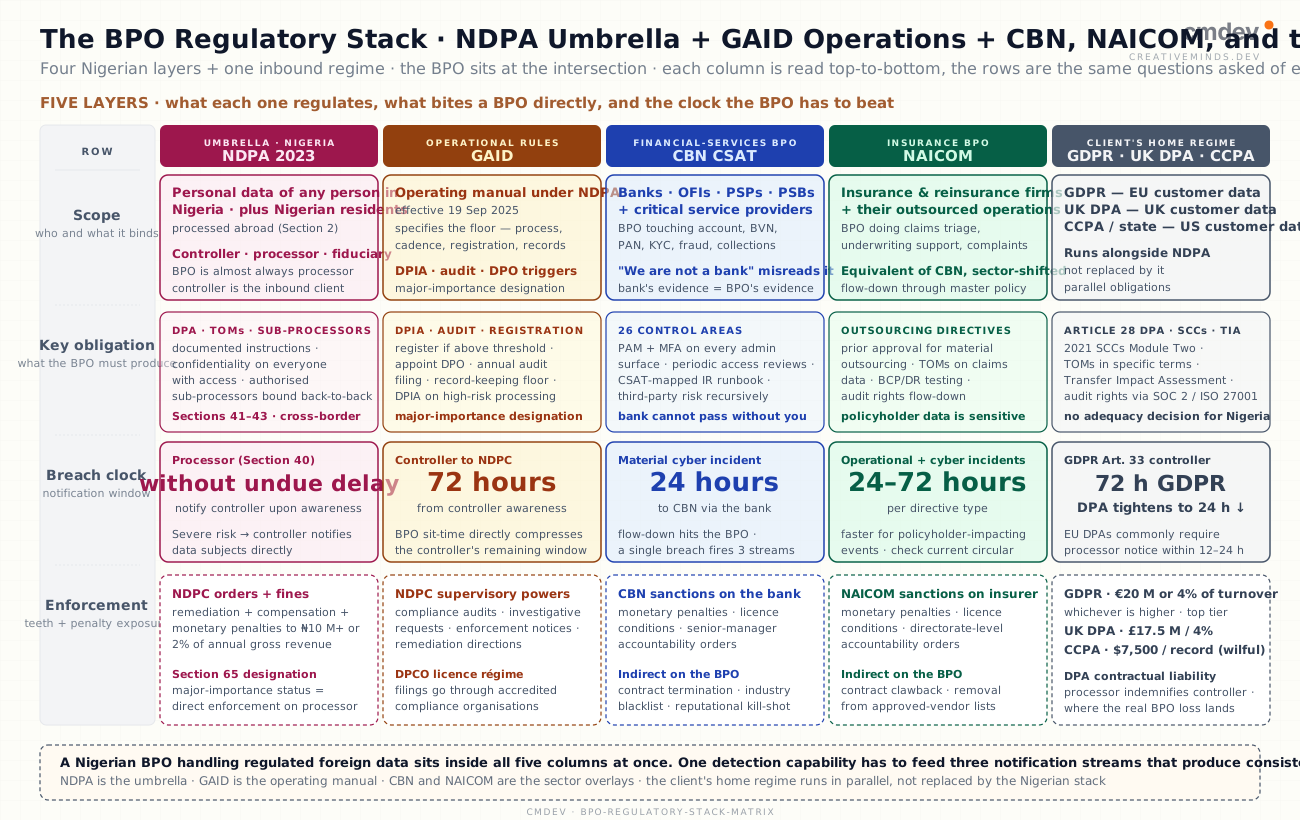
Four regulatory layers stack against a Nigerian BPO handling US, UK, or EU customer data, and they do not collapse into one another the way a procurement deck sometimes pretends they do. The NDPA 2023 is the umbrella. The General Application and Implementation Directive underneath it — GAID, effective September 2025 — is the operating manual that turns the Act into a checklist. The CBN's Cybersecurity & Information Security Compliance Framework, operationalised through CSAT, applies to any BPO touching Nigerian financial-services data. The NAICOM directives play the equivalent role for insurance work. And sitting on top of all four, never replaced by any of them, is the client's home regime — GDPR, UK GDPR, HIPAA, or whichever US state privacy law happens to apply. This piece walks the stack from the BPO's point of view, because that is the point of view doing the work.
Key takeaways
- BPO providers handling foreign customer data are almost always processors under the NDPA, not controllers, which shifts the obligations but does not remove them.
- The GAID 72-hour clock applies to controllers; processors notify the controller without undue delay, and EU-client DPAs tighten that to 24 hours or less.
- NDPA Sections 41-43 govern cross-border transfers; the NDPC has issued zero adequacy decisions, so SCC-equivalent terms ride on top of the GDPR Article 28 DPA structure.
- A BPO that handles Nigerian-bank customer data falls into CBN CSAT scope through the critical-service-provider provisions, even though it is not a bank.
- The audit chain that survives EU procurement scrutiny is principal-of-record discipline on every agent-routed interaction: identity, retrieval set, policy version, model and prompt version, and recording sealed into one event.
A Lagos Office Is an NDPA Case
The NDPA applies to every organisation processing personal data of people in Nigeria, and — through Section 2 — to organisations outside Nigeria processing data of Nigerian residents. A Lagos BPO processing the data of a French citizen does not look, on first reading, like an NDPA case. It is. The processing happens in Lagos. The processor is bound by the law of the place where the keystroke lands, in the same way that a chef in Paris cooking with imported tuna still works under French food-safety law.
GAID, effective 19 September 2025, is the operating manual that came down nine months after the Act. It specifies the 72-hour breach window, the DPIA triggers, the audit cadence, the registration obligations, the record-keeping floor. It is the difference between a constitution and a building code — the Act tells you what is illegal; the directive tells you which wires go where.
The CBN framework, operationalised through CSAT, is the financial-services overlay. It applies to banks, OFIs, PSPs, PSBs — and to their critical service providers, which is the doorway through which a BPO walks. A BPO running collections, KYC review, fraud triage, or call handling for a Nigerian Tier 1 bank is, in CBN's eyes, an extension of the bank's control surface. The bank cannot pass an assessment without producing evidence that the BPO's controls meet the bar. NAICOM plays the same role for insurance. The client's home regime — GDPR, UK GDPR, HIPAA — runs alongside the NDPA. None of the layers replaces another. They sit on top of each other like sediment, and the BPO works at the bottom.
Controller, Processor, and the Name on the Cheque
The NDPA distinguishes between controllers, processors, and the umbrella category of data fiduciary. A controller determines purposes and means — the inbound client, the entity whose business the data was collected to serve. A processor processes on documented instructions — the Nigerian BPO. Controller is the name on the cheque; processor is the cashier writing it out. The bank wants to know who signed; the law cares about both signatures.
Three obligations bite a processor directly. The first is documented instructions. The contract has to capture scope, purpose, duration, categories of data, categories of data subjects, and the processor's specific obligations — the artefact known as the DPA. "We have a master services agreement" is not the same artefact, in the same way that a restaurant reservation is not a marriage certificate. The second is confidentiality and security: appropriate technical and organisational measures, and confidentiality obligations on every person with access — agent, supervisor, QA reviewer. The NDPC does not prescribe specific controls. The market does. If the controller is GDPR-regulated, the processor is held to GDPR-equivalent controls in practice.
The third obligation is sub-processor discipline. No sub-processor — cloud vendor, translation service, workforce platform, sentiment analytics — without prior written authorisation, and the sub-processor must be bound by equivalent obligations. A BPO that quietly routes call recordings into an undisclosed analytics vendor has breached the primary DPA, regardless of whether the vendor's controls are perfectly fine. The breach is the routing, not the destination.
Section 65 raises a different stake. The Commission can designate certain organisations as data controllers of major importance — a category that captures processors handling data above threshold volumes. For a BPO running large outsourced call centres, that designation is the realistic posture, and it brings mandatory registration, DPO appointment, and direct enforcement exposure that does not flow through the controller.
Three Clocks Tick Simultaneously
GAID's 72-hour window is the most discussed provision of the directive and the most consistently misread. The 72 hours apply to controllers notifying the NDPC. Processors carry a parallel obligation under Section 40 — notify the controller "without undue delay" upon becoming aware — and the language is functionally equivalent to GDPR Article 33(2).
The practical effect compresses the BPO's timeline more than the directive lets on. The controller's clock starts the moment the controller becomes aware, and the controller becomes aware when the BPO tells them. If the BPO sits on a confirmed breach for 24 hours before notifying, the controller is suddenly running a sprint with 48 hours on the clock. EU-client DPAs typically tighten the processor's window to 24 hours, sometimes 12. For a BPO simultaneously handling Nigerian-bank data, the clock is shorter still — CBN's control areas require notification within 24 hours of material cyber incidents, and the bank's flow-down pushes that onto the BPO.
The honest description is that a single breach can fire three notification streams in parallel: NDPC under GAID, the EU client's DPO under the DPA, and the Nigerian bank's CSAT chain. One detection capability has to feed three communication procedures that produce consistent, regulator-grade facts at speed. Imagine a building where the smoke alarm has to ring through three different switchboards, in three different languages, and the operators on each line will compare notes afterwards. The architecture is unforgiving.
For severe breaches — those likely to result in high risk to the rights and freedoms of data subjects — direct notification to affected individuals is required. That call is almost always the controller's. The BPO's job is to give the controller the facts fast enough to make the call without inventing details.
The Border That Has No Adequacy
Cross-border transfer is where Nigerian BPO providers run into the most consequential structural gap. There are two directions to think about, and the BPO sits at both ends.
The inbound case is daily. An EU controller transferring data to a Nigerian processor is making a GDPR-restricted transfer outside the EEA. Nigeria has no European Commission adequacy decision and is not expected to receive one soon. The transfer needs a Chapter V mechanism, almost always the 2021 Standard Contractual Clauses, controller-to-processor module, backed by a Transfer Impact Assessment addressing Nigerian surveillance law and lawful access rights. Without it, every interaction is technically an unlawful transfer, which is the sort of finding that turns a procurement question into a regulator question.
The outbound case — Nigerian processor sending data on to a sub-processor abroad — is governed by NDPA Sections 41 to 43. Section 41 sets the conditions: adequacy, binding instruments such as SCCs or BCRs, explicit consent, or specific necessity grounds. The NDPC has issued zero adequacy decisions as of mid-2026, which includes the EU, the UK, and the US. Section 42 vests adequacy determinations in the NDPC. Section 43 carves out specific transfer grounds and obliges the transferor to assess the impact on data-subject rights.
In practice the SCC-equivalent mechanism is the workable path. The NDPC has published template clauses — not literally the EU SCCs, but functionally equivalent. For a BPO sitting between an EU controller and a sub-processor in a third country, the contractual stack has three levels: the controller's GDPR SCC with the BPO, the BPO's NDPA cross-border instrument with the sub-processor, and back-to-back terms ensuring GDPR protections survive the second hop. Any break in the chain is a finding waiting to happen, and the chain has a habit of breaking quietly at the second hop, where nobody on the controller's side is looking.
A Contract That Reads in Two Regimes at Once
The contract between a Nigerian BPO and an EU controller has to work in two regimes simultaneously. Article 28 is the surface the controller's DPO reads. The NDPA is the substantive layer the NDPC reads if an incident reaches them. The structure that survives both reviews has five components, and each one earns its keep.
The first is an Article 28-compliant DPA: subject matter, duration, nature and purpose, categories of data and data subjects, and the eight Article 28(3) processor obligations — documented instructions, confidentiality, security, sub-processors, data-subject rights assistance, breach assistance, deletion or return, audit cooperation. The second is the SCCs as an annex, Module Two of the 2021 European Commission set, docking clause executed, TOMs appendix completed in specific terms rather than "industry standard," and the redress mechanism populated rather than left as a placeholder.
The third is the Transfer Impact Assessment. Nigeria's access regime is permissive on paper — the Cybercrimes Act, the NCC's interception powers, the Communications Act lawful access provisions — though enforcement is uneven in practice. The TIA documents the risks, names the supplementary measures (encryption at rest with keys held outside the access regime, network segregation, hardware-keyed access), and states the residual risk the controller accepts. The fourth is the NDPA layer: a Nigeria-specific schedule referencing the NDPC registration, the appointed DPO, the GAID-compliant breach procedure, and the Section 41 cross-border instrument. EU controllers often do not know to ask for this. The competent BPO offers it before they have to.
The fifth is audit rights. Article 28(3)(h) gives the controller audit rights, and most BPOs cannot host individual customer audits at scale. The workable answer is a third-party assurance — ISO 27001, SOC 2 Type 2, or a sector certification — with a contractual right to deeper audit if the standard is breached. The structure survives EU scrutiny because it does not pretend the NDPA is GDPR-equivalent. It treats the two as parallel obligations and shows the controller the seams.
When the Bank's Audit Becomes Your Audit
CBN's framework applies directly to banks, OFIs, PSPs, and PSBs, and indirectly — through the critical-service-provider provisions — to the BPOs that serve them. A BPO handling customer service touching account or transaction data, collections, KYC and onboarding review involving BVN data, fraud triage and card-dispute work touching PAN data, or voice analytics over recordings is in scope, whether or not it carries a banking licence.
CSAT structures itself around 26 control areas across governance, identity, network, endpoint, application, data, third-party, incident, and resilience. The bank's CSAT submission has to demonstrate that the BPO's controls meet the bar in each relevant area — the bank's evidence is the BPO's evidence. There is no daylight between the two. The practical implications cascade out: privileged access management and MFA on every administrative surface, periodic access reviews, network and endpoint controls on BPO infrastructure, a CSAT-mapped incident runbook, and third-party risk management over the BPO's own sub-processors recursively. A BPO that positions itself outside financial-services scope on the basis that "we are not a bank" has misread the framework. The bank's regulator does not care which company's logo is on the building. The regulator cares whose hands touched the data.
Principal of Record on Every Interaction
For any agent-routed interaction — voice call, chat, ticket, claim review — the audit chain a regulated client now expects is principal-of-record discipline: five facts attached to the event and surviving the retention period. The agent identity, authenticated through an enterprise IdP and attributed to a named individual with role and queue. The retrieval set, captured by record and access path. The policy active at the time — for AI-assisted workflows, the model version, prompt version, guardrail configuration, and eval suite in force; for human workflows, the SOP version. The interaction record itself, call recording or chat transcript or screen capture, stored with cryptographic integrity. And the lawful basis chain, naming the controller's basis under GDPR or NDPA, the consent record where consent applies, and the deletion event when retention expires.
A SOC 2 Type 2 report, ISO 27001 certificate, or PCI DSS attestation is the externalised surface this audit chain produces. The certificate is not the discipline. The discipline is what the auditor finds when they ask for any one of those five facts on a randomly chosen interaction from six months ago.
The First Twenty-Four Hours Decide Everything
A confirmed breach is a clock that nobody can pause. The first twenty-four hours decide whether exposure is contained or compounded, and the playbook that holds is a four-phase one.
In hours zero to six, the SOC confirms and classifies the incident, identifies affected data categories, engages the DPO, and notifies the controller's DPO with what is known, what is unknown, the next investigation steps, and the timeline for the next update. This buys the controller the time it needs for its own 72-hour clock. In hours six to twenty-four, the focus shifts to containment and forensic preservation — every action and every actor time-stamped, every change-window logged. This is the record the NDPC will read.
In hours twenty-four to seventy-two, the BPO submits its NDPC notification through the GAID-prescribed channel, the controller submits to its lead supervisory authority on the BPO's facts, and for financial-services BPO the CBN stream runs in parallel through the client bank. Past day four, direct subject notification — where required — is executed by the controller. The BPO drives remediation: root cause, control gaps, corrective actions, change-management record. The documentation that survives a regulator's reading is contemporaneous, specific, and honest about uncertainty. What is not known is stated as not known, not invented in retrospect.
"Our Laptops Are Encrypted" Is Not Compliance
The line that keeps surfacing in procurement conversations — "we are GDPR compliant because our laptops are encrypted" — survives a sales call and does not survive a DPO audit. Disk encryption is one control. It does not demonstrate Article 28 compliance, lawful cross-border transfer, sub-processor discipline, the breach procedure, the records of processing activity, or the technical and organisational measures the controller is obliged to verify. Calling it compliance is calling a single brick a house.
The evidence that actually satisfies an auditor lives in a folder, not a slogan: the signed DPA with the controller, with SCCs and TIA executed; the records of processing activities under Article 30 or NDPA Section 30, current; the NDPC registration and the appointed DPO's contact and qualifications; the sub-processor list with each one's authorisation, DPA, and risk assessment; the breach procedure with time-stamped tabletop results; the access-control matrix for every agent role with the last review date; encryption posture at rest and in transit with KMS records; audit log retention and cryptographic integrity controls; and a SOC 2 Type 2 report, ISO 27001 certificate, or equivalent third-party assurance.
A BPO that can produce these on request is defensible with the NDPC, the CBN, and the inbound client's home regulator. A BPO that cannot will eventually meet an audit that does not let it past. The window in which an encrypted-laptop claim was enough is closing — and the next contract, the one being negotiated this week in Frankfurt and Frankfurt-shaped offices across Europe, is the one that closes it.
FAQs
Is a Nigerian BPO a controller or a processor under the NDPA?
Almost always a processor. The inbound client is the controller. Processor status does not remove NDPA obligations; it changes which ones bite — registration where applicable, DPO appointment if thresholds are met, records of processing activities, appropriate security, sub-processor control, and notification of the controller without undue delay.
Does GAID's 72-hour breach window apply to a BPO acting as a processor?
The 72-hour clock applies to controllers notifying the NDPC. Processors have a parallel Section 40 obligation to notify the controller without undue delay. EU-client DPAs tighten that to 24 hours or less so the controller can meet its own clock, and a BPO handling Nigerian-bank data is simultaneously bound by the CBN's 24-hour material-incident chain.
How does an EU controller lawfully transfer personal data to a Nigerian BPO?
Through the 2021 European Commission SCCs, Module Two (controller-to-processor), backed by a Transfer Impact Assessment addressing Nigerian public-authority access. The NDPC has no adequacy decision from the European Commission, so the SCCs are the workable Chapter V mechanism. The NDPA's own cross-border instrument layers into a Nigeria-specific schedule but does not replace the SCCs.
When does a BPO fall into CBN CSAT scope without being a bank?
When it is a critical service provider to a CBN-regulated entity. Customer service touching account data, collections, KYC review, fraud triage, card disputes, and call analytics for a Nigerian bank all qualify. The bank's CSAT submission depends on the BPO's controls across identity and access, network and endpoint, application security, data protection, third-party risk, and incident response.
What is the single highest-priority artefact a BPO should produce for procurement?
A signed DPA with SCCs and TIA executed, supported by an independent third-party assurance — SOC 2 Type 2, ISO 27001, or a sector attestation. Procurement teams look for the documented instructions, the eight Article 28(3) obligations, the sub-processor list, the breach procedure, the records of processing activities, and the audit cooperation surface.
Companion Content
- NDPA and GAID: What Every Nigerian Organization Must Know — the umbrella regulatory primer this article narrows down
- CBN CSAT Compliance Roadmap — the financial-services overlay in detail
- Lagos CyberSafe 2026 Compliance Guide — the Lagos State layer for BPOs in the digital economy zone
- Nigeria Cybersecurity Outlook 2026 — market and infrastructure context for foreign clients evaluating Nigerian BPO partners
- IAM for AI Agents: Delegation and Principal Scoping — the agent-routed identity discipline that produces the audit chain regulated clients expect
How to engage
We help BPO providers design the regulatory architecture that survives EU, UK, and US client audits, and we help inbound clients evaluate Nigerian BPO partners against the NDPA, GAID, CBN CSAT, and the relevant home-jurisdiction regime. The work spans the DPA and SCC structure, the cross-border transfer assessment, the breach-procedure tabletop, the CSAT control mapping, and the audit-chain instrumentation. Talk to us at creativeminds.dev/contact.