The planning meeting starts at ten. By ten-fifteen, the head of engineering has pulled up a LinkedIn post arguing that retrieval-augmented generation is dead because Gemini now holds two million tokens in context. The team's vector store work — three months of it — is suddenly on the chopping block. Someone asks whether they should rip it out and ship the whole corpus in the prompt. The architect at the back of the room asks how many queries a day the workload handles. The number is 30,000.
The conversation ends there. The math on 30,000 queries a day against a million-token prompt does not survive a finance review. Long-context is real. So is the bill it produces if you point it at the wrong workload.
Gemini 2.5 Pro ships with a one-million-token context window, with the two-million expansion listed as forthcoming on the Google AI pricing page. Claude Opus and Sonnet now offer a one-million-token context at flat input pricing — no surcharge once a request crosses any threshold. OpenAI is pushing the same direction with the GPT-4.1 family. The frontier moved. The question every engineering lead is now asked, usually in a planning meeting and usually by someone who has just read a LinkedIn post, is whether retrieval-augmented generation is over.
The engineering reading is the boring one. Long-context is a real architectural shift that changes the shape of what we can build. It does not eliminate retrieval. The workloads where long-context dominates are narrow and well-defined. The workloads where retrieval still wins are most of production. The pattern most teams actually ship combines both, and the cost-and-latency math determines which architecture handles which query.
Key takeaways
- Long-context delivers single-call reasoning over a bounded corpus without an upstream retrieval layer choosing what the model sees — a real win for multi-hop synthesis on medium corpora, not a replacement for retrieval over thousands of documents.
- Needle in a Haystack is a retrieval benchmark, not a reasoning benchmark; near-perfect NIAH scores coexist with poor multi-step reasoning, and the long-context marketing is mostly NIAH-shaped while the workloads that justify long-context are synthesis-shaped.
- Worked example: a 10M-token corpus at 50 queries per day costs ~$56/month on RAG, ~$45,000/month on naive long-context with Claude Sonnet, and ~$4,500/month with aggressive prompt caching — RAG wins by an order of magnitude or more once query volume scales.
- Cold-start time-to-first-token on a million-token prompt lands in the three-to-fifteen-second range; vector search returns in fifty to two hundred milliseconds, and the gap compounds in agent loops where each step blocks on the previous step's full output.
- The pattern most production teams ship is hybrid: vector retrieval narrows the corpus to a relevant subset, long-context reasons over that subset in full fidelity, and routing rules decide which mechanism handles which query.
What The Frontier Actually Changes
Long-context delivers one thing that prior architectures could not: single-call reasoning over a large body of related content, without an upstream system deciding which fragments the model gets to see. Think of it as the difference between asking a librarian who picks five relevant pages from a thousand-page book and handing the whole book to a careful reader. Both have value. They are not the same operation.
The wins that follow from this are specific. Multi-hop reasoning across a medium corpus — a legal matter file, an incident-investigation dossier, a research notebook — works in a single call where it used to require either a long agent loop or a retrieval system that returned the right combination of evidence chunks. Cross-document synthesis improves, because the model is not reasoning over chunks the retrieval layer selected; it is reasoning over the original documents in their full form. Document-comparison tasks — "diff these two contract drafts and tell me what shifted in favour of the counterparty" — become trivially expressible. For Gemini specifically, the multi-modal long context lets video, PDF, and audio sit in the same prompt as the text, which is a genuinely new capability surface.
The benchmark most often cited for this — Needle in a Haystack — is also the one that has driven the most overclaim. NIAH measures whether a model can locate a planted fact inside a long context. It is a retrieval test, not a reasoning test. Recent work (NoLiMa, NeedleChain, LongBioBench) has made the point explicit: near-perfect NIAH scores coexist with surprisingly poor multi-step reasoning across the same context. Long-context models can find the needle and still fail to compose three needles into an argument. The benchmark you want to read is LongBench or an equivalent task suite that tests synthesis, not lookup.
This matters because the marketing for long-context is mostly NIAH-shaped, and the actual production workloads that justify long-context are mostly synthesis-shaped. The two are not the same.
What Stays Exactly Where It Was
Four things do not move.
Corpus retrieval across thousands of documents. If your corpus is fifty thousand support articles, a million contracts, or ten years of internal email, you cannot put it in any prompt at any context window. Vector search exists because approximate nearest-neighbour over embeddings scales to billions of items with sub-100ms latency. No frontier-model context window approaches the scale where this stops mattering. Trying to bypass retrieval here is like trying to read every book in a national library to answer one question.
The cost curve. Long context is expensive per call. Gemini 2.5 Pro charges $1.25 per million input tokens below the 200K threshold and $2.50 per million above it. Claude Opus charges $5 per million input tokens; Sonnet charges $3. Every call that ships a large corpus in the prompt pays the full input-token cost on that corpus, every time. Retrieval amortises the corpus cost into a one-shot embedding bill, then pays only for the retrieved fragments per query. The two cost curves cross at a specific volume — we work through it below — and the crossover is not flattering to long-context on high-traffic workloads.
The latency curve. Cold-start time-to-first-token scales with context length. Independent benchmarks put a one-to-two-million-token prompt in the multi-second range before the model emits its first token. Production numbers we see from clients land in the same band — three to fifteen seconds depending on cache state, model, and provider load. Vector search returns in fifty to two hundred milliseconds. For a chat interface where streaming output starts after the first token, the gap is hidden behind the typing animation. For an agent loop where each step needs the previous step's output before deciding the next action, the gap compounds across every iteration.
The freshness problem. A corpus that updates daily — pricing, inventory, policy, support content — has to be re-encoded into every long-context prompt to reflect the latest state. Retrieval pulls the freshest version of each chunk at query time. Long-context, in the naive form, asks you to either ship a stale corpus or re-construct the prompt from scratch on every change, which interacts poorly with prompt caching because the cache key changes every time the corpus does.
There is also a quieter problem the eval teams keep flagging. Long-context behaviour is harder to test than retrieval behaviour. With RAG, you can inspect the retrieved chunks, score whether retrieval found the right evidence, score whether the synthesis is grounded in that evidence, and audit the trace end-to-end. With long-context, the model's retrieval is an internal attention pattern over a massive prompt — and the failure modes (drift, position bias, the lost-in-the-middle effect) are harder to surface in a regression suite.
The Cost Math, Worked Out
Take a concrete example. A 500-document corpus. Average document length 20,000 tokens. Total corpus size: 10,000,000 tokens. Query volume: 50 queries per day, each generating roughly 500 output tokens.
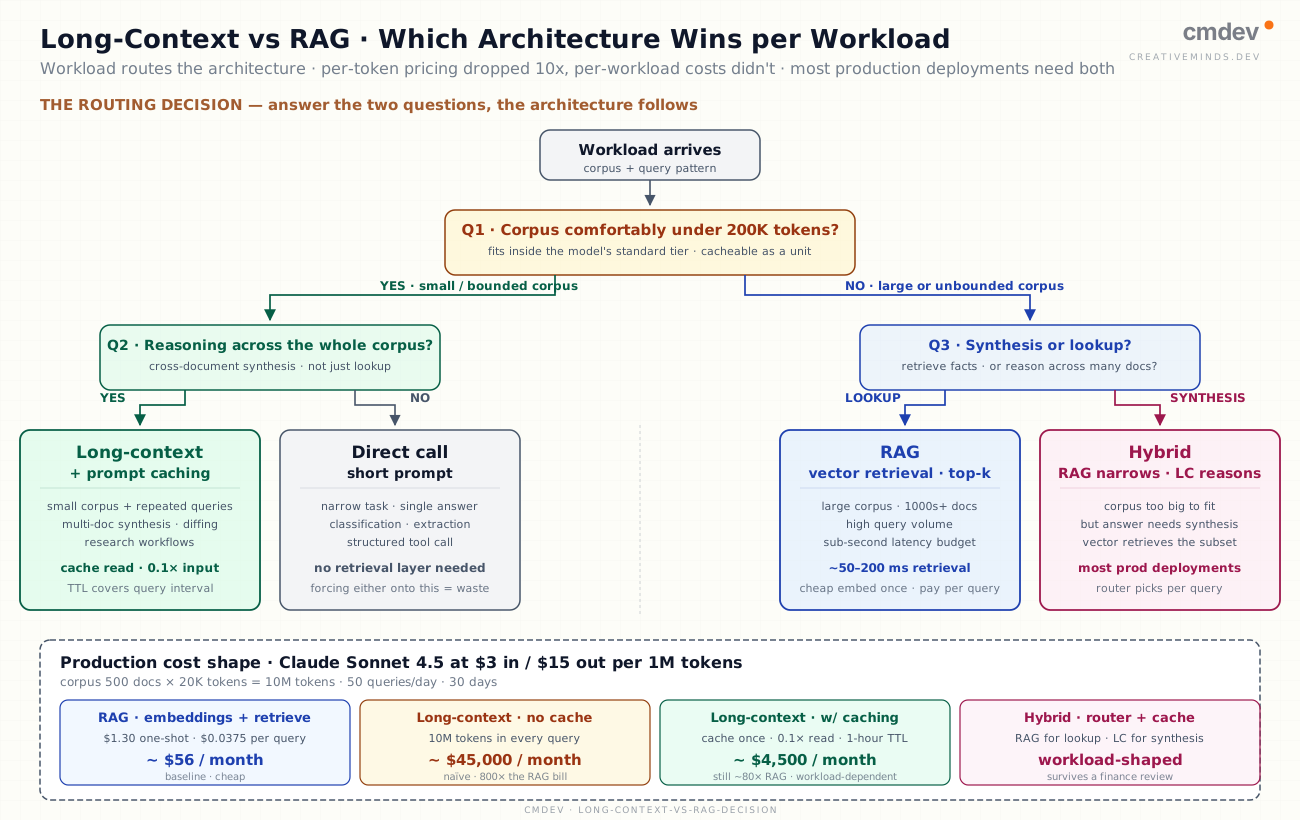
Architecture A — RAG with embedding-based retrieval. Embed the corpus once with OpenAI's text-embedding-3-large at $0.13 per million tokens. Indexing cost: 10M tokens × $0.13 / 1M = $1.30 one-shot. Vector store running cost: trivially small for a corpus this size on any managed service. Per query: retrieve top-five chunks of 2,000 tokens each (10,000 input tokens), generate 500 output tokens. Using Claude Sonnet at $3 input and $15 output per million tokens: (10,000 × $3 + 500 × $15) / 1M = $0.0375 per query. Fifty queries per day × thirty days = 1,500 queries per month. Monthly cost: **$56 per month plus the one-off $1.30**.
Architecture B — Long-context with full corpus in every prompt. Ship the full 10M-token corpus into Sonnet on every query. Per query: 10,000,000 input tokens, 500 output tokens. Cost per call: (10,000,000 × $3 + 500 × $15) / 1M = $30.0075. Per day: $1,500. Per month: ~$45,000. Even on Gemini 2.5 Pro at the lower end of its tiering ($2.50 per million input above 200K), the corpus is ~$25 per call, ~$1,250 per day, ~$37,500 per month.
Architecture C — Long-context with prompt caching. Cache the corpus with Anthropic's prompt caching API. Cache write at 1.25× input cost on the first call: 10M × $3.75 / 1M = $37.50 once per cache window. Cache reads at 0.1× input cost on subsequent calls within the five-minute (free) or one-hour ($60 storage premium) TTL: 10M × $0.30 / 1M = $3.00 per query plus the output cost. If all fifty queries fit inside the one-hour cache window in batched workloads, the monthly cost lands around $4,500 — an order of magnitude cheaper than naive long-context but still seventy to eighty times the RAG bill.
The crossover is workload-shaped, not architecture-shaped. Long-context becomes cost-competitive with RAG when the corpus is small (sub-200K tokens, comfortably inside the standard tier), the query volume is low enough that the per-call cost stops compounding, and caching is aggressive enough to pin the per-call read cost near zero. For a 100K-token corpus and ten queries a day, long-context with caching costs roughly the same as RAG. For a million-token corpus or a hundred queries a day, RAG wins by an order of magnitude and the gap grows from there.
The Latency Math, Worked Out
RAG with vector search runs in fifty to two hundred milliseconds for retrieval, plus generation latency on a ~10K-token input. End-to-end is usually under a second to first token on a streaming response.
Long-context with a multi-million-token prompt sits at cold-start time-to-first-token in the three-to-fifteen-second range for an uncached prompt. Hot-cache reads are dramatically faster — caching is the lever — but the first call into a fresh cache pays the cold cost, and any cache miss (corpus update, TTL expiry, cold serving instance) repays it.
Streaming output mitigates the perception of latency for chat-style interfaces, but it does not help two cases that matter in production. Agent loops, where each step blocks on the previous step's full output. And API integrations, where downstream systems consume a complete response rather than a token stream. In agent loops, a five-second TTFT becomes a thirty-second multi-step run — like running a relay race where every baton handoff requires a five-second pause.
The latency budget is not a footnote. It determines what UX patterns the architecture can support.
Four Scenarios, Cleanly Bounded
The architecture choice is workload-driven, not preference-driven.
Long-context wins on small corpora comfortably under 200K tokens; high-value, low-volume queries like executive briefings, one-off analyses, due-diligence reports; workloads where the model genuinely needs to synthesise across documents rather than retrieve from them; latency-tolerant interfaces where a five-second response is acceptable; and multi-modal tasks where video, audio, and text need to be reasoned about together.
RAG wins on large corpora of thousands or millions of documents; high query volume — anything north of a few hundred queries per day starts to compound; latency-sensitive interactive UX like customer-facing chat, real-time support, anything with a sub-second budget; frequently-updating content where per-chunk freshness matters; and cost-sensitive deployments where per-query economics are the gating constraint.
Hybrid wins on most production deployments we actually ship. Vector retrieval narrows the corpus to a relevant subset. Long-context then reasons over that subset in full fidelity. The retrieval layer handles "which documents." The long-context model handles "what do these documents together actually mean." This is the architecture that pays for itself, and the one most clients land on once the cost projections come out of the spreadsheet.
Neither wins on workloads where the model needs neither. Structured-data tasks where the answer is a SQL query over a database. Narrow tool-calling where the model selects a function and arguments and lets a deterministic system do the work. Workflows where the right answer is a classification or an extraction, not a synthesis. Forcing long-context or RAG onto these workloads is overhead with no upside.
Prompt Caching Changes The Math
The cost analysis above already incorporates caching, but the strategic implication deserves its own beat. Anthropic's prompt caching charges 1.25× input cost to write the cache (5-minute TTL, no storage fee) or 2× to write the one-hour cache, and 0.1× input cost for every read. Gemini's context caching follows a similar curve — cache reads at 10% of base input price, plus an hourly storage fee that for Gemini 2.5 Pro lands at $4.50 per million tokens per hour.
For repeated queries against the same corpus inside a single session — a research workflow, an iterative analysis, a multi-turn investigation — caching closes a significant fraction of the gap between long-context and RAG. The corpus is paid for once per cache window and read at near-input-cost-zero on subsequent queries. This is the configuration where long-context is genuinely competitive: small enough to cache, queried enough times inside the TTL to amortise the write cost, and reasoned across in ways retrieval cannot replicate. Think of it as renting a meeting room for the hour — only worth it if you fill the room with meetings.
For one-off queries spread across hours or days, caching does not help. The TTL expires before the second query lands. The architecture pays the cold cost every time. Knowing which side of this line your workload falls on is the single highest-leverage piece of cost work the architecture review can do.
The Shape Of Frontier-Model Economics
Two patterns sit underneath all of this.
The "long-context killed RAG" framing is the same shape as the "vectorless RAG killed vector search" framing we wrote about previously — a real architectural innovation, narrowly scoped, generalised by marketing into something the engineering does not support. The right reading is not which architecture wins. The right reading is which architecture wins for which workload, and how to compose them into a system that picks the right mechanism per query.
The economic shape of frontier-model inference is fixing the answer. Input-token costs are dropping fast, but the curve does not bend fast enough to make multi-million-token prompts cheap at production volume. Caching helps and is doing real work in the cost analysis above, but caching is a latency-and-cost optimisation, not an architectural escape. As long as input pricing is per-token and storage is per-token-per-hour, retrieval will remain the more efficient mechanism for high-volume, large-corpus workloads, and long-context will remain the better mechanism for synthesis-heavy work over bounded content.
The teams who will ship the most defensible production AI over the next eighteen months are not the teams who pick one architecture and stick to it. They are the teams who can articulate, with numbers, why a given query is routed to retrieval, to long-context, or to a hybrid pipeline — and can defend the routing rules to a finance review and an auditor in the same meeting.
If someone in your next planning meeting argues that long-context just killed RAG, what is the per-query budget on the workload they are talking about?
FAQs
Has long-context made RAG obsolete?
No. Long-context is a real architectural shift on a narrow class of workload — small bounded corpora, low query volume, latency-tolerant synthesis. Retrieval still wins on the majority of production deployments: large corpora, high query volume, latency-sensitive UX, and frequently-updating content. Most teams that work the cost math end up on a hybrid.
What is the rough crossover point on cost?
Long-context becomes cost-competitive when the corpus is under ~200K tokens, the query volume is low enough that per-call cost stops compounding, and prompt caching pins the per-call read cost near zero. For a 100K-token corpus at ten queries a day, long-context with caching costs roughly the same as RAG. For a million-token corpus or a hundred queries a day, RAG wins by an order of magnitude and the gap widens.
Does prompt caching close the gap?
Partially. Anthropic's cache write costs 1.25x input (5-minute TTL) or 2x (1-hour TTL with a storage premium), and reads cost 0.1x input. For repeated queries inside a single session it makes long-context genuinely competitive. For one-off queries spread across hours or days the TTL expires before the second query lands and the architecture pays the cold cost every time.
Why does latency matter so much for agent loops?
In a chat UX, streaming output hides cold-start latency behind the typing animation. In an agent loop, every step blocks on the previous step's full output before deciding the next action, so the cold-start cost compounds across iterations. A five-second TTFT becomes a thirty-second multi-step run. API integrations that consume complete responses rather than token streams hit the same problem.
When is neither long-context nor RAG the right choice?
When the model does not need either. Structured-data tasks where the answer is a SQL query, narrow tool-calling where the model picks a function and arguments, classification and extraction tasks where the right output is a label rather than a synthesis. Forcing long-context or RAG onto these workloads is overhead with no upside.
Companion content
- The PageIndex Question: Tree-Based Retrieval, Real Trade-Offs, and the Hybrid That Actually Ships
- RAG with Amazon Bedrock Knowledge Bases
- Optimising Cold-Start Latency and Cost of Multimodal RAG Pipelines
- Cost Optimisation on Amazon Bedrock
- Why 95% of Enterprise AI Pilots Fail at the Deployment Phase
How to engage
We design and ship retrieval, long-context, and hybrid AI architectures for regulated enterprises — with the cost and latency projections that let the architecture choice survive a finance review. Talk to us at creativeminds.dev/contact.