It is twenty past seven on a Tuesday morning in Yaba. The lights are already on inside the operations floor — not strip lighting, but the kind of indirect lamps you find in a Slack office in Stockholm. Two graduates with first-class economics degrees from the University of Lagos are settling into adjacent stations, headsets warming up, dashboards rendering. Today is week seven on the floor for both of them. Their first call will come from a customer in Manchester at 08:30 local. The model on their screen will write the first draft of the response, they will edit it, and the audit trail behind it will look, in structure, very much like the audit trail of a banking compliance interaction. Neither of them is reading from a script. Neither of them is what most of the procurement decks evaluating Nigerian BPO partners think a Nigerian BPO agent is.
Most buyers are still working from a mental picture that is ten years old: rows of agents in a Lagos office reading from a script, priced at a fraction of the equivalent EU or US seat, pure labour arbitrage with quality as the obvious risk. That model still exists in places. It is no longer how serious managed BPO operations run, and it is not what a current engagement at cmdev looks like at all. The shift is closer to the gap between a 2010 hatchback and a current EV — same word, almost nothing in common under the bonnet.
What the current model looks like in practice is a six-week training programme that splits onboarding into customer-service fundamentals and tool fluency, a two-shift rota that gives a single operations centre coverage across US East, UK, and EU business hours, an AI-augmented agent workflow where the model drafts every response and the human edits or accepts it, and a supervisor structure tight enough to hold tier-1 quality above a measurable threshold without burning the floor out. The unit economics that result are not the headline rate of a headcount-arbitrage shop. They are the loaded cost of a managed service. They are still meaningfully cheaper than the equivalent in-house function in London or New York, and the gap is structural rather than temporary.
What follows is the operational deep dive: talent pipeline, training, shifts, the AI-augmented workflow, the supervisor structure, quality assurance, unit economics, and the cases where this model does not fit.
Key takeaways
- Nigeria graduates roughly 600,000 students a year and has built a parallel technical talent pipeline — Andela, Decagon, Semicolon Africa, ALX — that has reshaped what a BPO hiring funnel can recruit against. The agents we deploy are not script-readers; they are graduates with English fluency, basic technical literacy, and an aptitude for tool-augmented work.
- Training has split into two tracks. Traditional BPO onboarding runs four weeks. AI-augmented agents run six weeks — and the additional two weeks are not customer-service basics, they are tool fluency: prompt patterns, when to edit a model draft, when to escalate, how to read the audit trail.
- Lagos sits at GMT+1, which gives a single operations centre coverage of EU hours (08:00–18:00 local), UK hours (08:00–19:00 local), and a second shift covering US East (08:00–17:00 ET) — a genuine follow-the-sun pattern from one geography, not two.
- The supervisor ratios that hold quality at scale are 1:8 for tier-1 work and 1:5 for complex or regulated workloads, with real-time monitoring via Amazon Connect Contact Lens and defined escalation triggers — not a single supervisor managing thirty agents and hoping the quality holds.
- The fully-loaded cost per interaction at scale runs €1.30–€1.80 in Lagos, against €4–7 in the EU and €6–10 in the US. The gap is structural, not arbitrage — it survives wage growth, infrastructure investment, and the cost of running AI tooling on top.
The Pool Is Deep, Not Shallow
The single most misread input to a Nigerian managed BPO operation is the talent pool itself. Nigeria graduates roughly 600,000 students from tertiary institutions every year, with Lagos and Abuja concentrating a disproportionate share. Graduate unemployment is high enough that a recruiter advertising a structured BPO role — with training, defined progression, and exposure to AI tooling — is fishing in a deep, well-stocked pond rather than scraping the bottom of a barrel.
Layered on top of the general graduate pipeline is a parallel technical talent ecosystem that did not exist ten years ago. Andela trained software engineers for global remote roles. Decagon runs intensive software engineering programmes. Semicolon Africa offers a two-year applied learning model. ALX runs programmes across software, data, and cloud. None of these are BPO training programmes. All of them have produced graduates whose realistic next-step options now include managed-services roles where the work is tool-augmented rather than purely conversational, and where the compensation curve is closer to a junior technology role than a traditional call-centre seat. It is roughly the difference between fishing for a job and fishing for a career.
The cmdev hiring funnel walks the candidate through three gates. Open applications get filtered for English fluency, both written and spoken; basic literacy with consumer technology; and a cognitive aptitude screen calibrated against the specific workload. Roughly 8 to 12 per cent of applicants pass that initial screen. Those who do go through a structured interview with a behavioural component and a role-play exercise simulating an inbound customer interaction. Roughly half of interviewed candidates receive an offer. The acceptance rate sits above 80 per cent because the structured training, the defined progression path, and the exposure to AI tooling is genuinely attractive against the alternative graduate market — Lagos has many entry-level office jobs and few that come with both a curriculum and a measurable career trajectory.
The agents who reach a customer interaction are not the script-readers of the old mental picture. They are graduates with the verbal fluency to handle a US or UK customer, the cognitive flexibility to read a model-generated draft and decide whether to send it, and the patience to work through a six-week structured programme before they take their first live call.
Two Weeks That Change the Operation
Onboarding splits into two tracks depending on the workload. The traditional BPO track runs four weeks. The AI-augmented track runs six. Most of the gap lives in the final two weeks, and most of the operational advantage lives in that gap.
The four-week track moves through familiar territory. Week one is product and policy — what the client sells, what the support boundaries are, what gets escalated. Week two is customer service fundamentals: tone, de-escalation, structured listening, the verbal scaffolding of a professional support interaction. Week three is system fluency, walking the CRM, the ticketing platform, the knowledge base, the contact-centre interface. Week four is supervised live calls with a senior agent or supervisor sitting alongside, the agent moving from observation to assisted handling to solo handling over the course of the week. Anyone who has run a contact centre will recognise the shape.
The AI-augmented track repeats those four weeks and then adds the two weeks that change everything. Week five is prompt and draft literacy. The agent learns the shape of the model-generated drafts they will be working with — what a good one looks like, what a bad one looks like, the failure modes that show up most often (overconfident hallucinations, policy misreads, tone mismatches). They learn the editing patterns the workflow expects: when to accept the draft as-is, when to lightly edit, when to discard and write from scratch, when to escalate rather than send. They learn to read the model's confidence signals and weight them appropriately against their own judgement, which is closer to the discipline of a sub-editor reviewing a journalist's copy than to the discipline of an agent reading a script.
Week six is audit-trail literacy and edge-case handling. Every interaction in the AI-augmented workflow generates a record of the model draft, the agent's edits, and the final output that reaches the customer. The agent learns how that record gets used downstream — by QA, by the supervisor, by the client's compliance team — and the knowledge of how the record will be read changes how the editing happens. The same week covers the edge cases that the prompt patterns do not handle cleanly: regulated information requests, suspected fraud, escalations to legal, accessibility accommodations. By the end of week six, the agent can work the AI-augmented loop fluently and knows when to step outside it.
The two-week investment in tool fluency is not optional. Skipping it produces agents who either over-trust the model (sending hallucinated responses straight to the customer) or under-trust it (rewriting every draft from scratch and capturing none of the productivity gain). Both failure modes appear within the first month on the floor, and both are visible in QA scores by week eight. It is the difference between teaching a junior driver how the new car handles and putting them straight onto the motorway.
A Single Centre That Catches Three Continents
Lagos sits at GMT+1 year-round. There is no daylight savings adjustment to argue with. That one geographical fact is the structural advantage that makes a Lagos-based managed BPO operation defensible against alternatives in Manila, Eastern Europe, or Latin America for a Western client base.
The shift map from GMT+1 reads cleanly. EU business hours — 08:00 to 18:00 across most of the bloc — get covered by a single Lagos shift starting at 08:00 local, with a one-hour overlap into Central European Time. UK business hours, 08:00 to 19:00 BST, are covered by the same shift, with the second half of the UK day handled by an extended rota running to 19:00 or 20:00 Lagos. US East business hours, 08:00 to 17:00 ET, start at 13:00 GMT+1 and run to 22:00 — which is the second Lagos shift, beginning at 13:00 local and finishing at 22:00.
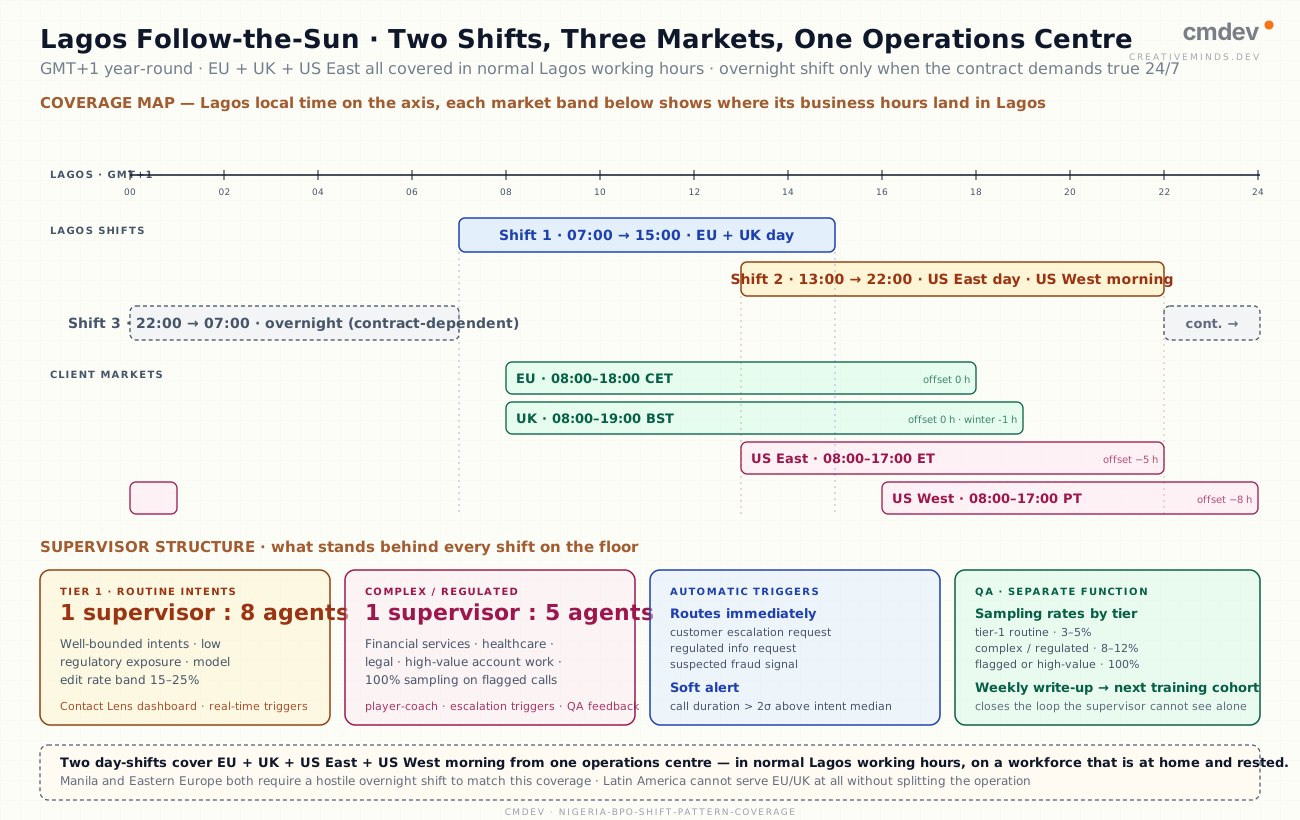
Two shifts. One operations centre. Genuine business-hours coverage across three of the world's largest customer-service markets, all run by a workforce that is at home, rested, and on the same school-run schedule as the rest of the city. Compare it to the alternatives. Serving the same coverage from Manila demands a hostile overnight shift for EU and UK hours. Serving it from Eastern Europe demands a hostile overnight shift for US hours. Serving it from Latin America offers no EU or UK coverage at all without splitting the operation in two. Lagos catches all three from one place. It is the difference between a goalkeeper who reaches every corner of the net and three goalkeepers covering different thirds.
The follow-the-sun pattern is not theoretical. It is the operational reason a single Nigerian centre can carry the customer-experience function of a multinational without the geographic split, the cross-team handoff overhead, and the two- or three-region procurement workload that comes with a multi-centre BPO contract.
The Draft, the Edit, and the Audit Trail
Every inbound interaction — voice, chat, email, social — flows into a unified queue and routes to an available agent. The shape of the workflow is straightforward: a generative model drafts a candidate response, the agent reviews and edits, and the edited version is what reaches the customer. The audit trail captures the model draft, the agent's edits, and the final sent text or spoken response. It is closer in spirit to a newspaper's copy desk than to a traditional call centre — the reporter files, the sub-editor sharpens, the paper goes out.
For voice interactions, the workflow runs on Amazon Connect with Contact Lens for real-time transcription and analysis, and a Bedrock-hosted model generating either a suggested response in agent-assist mode or a draft of the agent's next utterance. For chat and email, the same pattern applies — Connect routes the conversation, the model generates a draft, the agent reviews and sends. The model has access to the client's knowledge base via a retrieval-augmented generation pipeline, so the drafts are grounded in the client's documentation rather than in whatever the model absorbed during training.
The agent's editing rate is the key operational metric. A well-tuned workflow on a routine support intent runs at 15 to 25 per cent edit rate — the model draft is good enough to send as-is roughly three quarters of the time, and the agent's role is to catch the cases where it is not. Edit rates above 50 per cent mean the model is poorly tuned for the workload and the productivity gain has disappeared. Edit rates below 5 per cent mean the agents are over-trusting the model and not catching errors that QA later finds. The target band is narrow and is monitored continuously.
The productivity gain at the target band is substantial. An AI-augmented agent on routine workloads handles roughly 1.8 to 2.4 times the interaction volume of a traditional agent on the same workload, at quality scores that match or exceed the traditional baseline. That ratio is what makes the unit economics of the AI-augmented model work. The agent is not cheaper individually; the throughput per agent is multiplied, and the per-interaction cost falls accordingly.
The Player-Coach on the Floor
The supervisor-to-agent ratio is the single largest determinant of quality at scale. The two ratios that hold up in practice are 1:8 for tier-1 work — routine support, well-bounded intents, low regulatory exposure — and 1:5 for complex or regulated workloads, where financial-services support, healthcare, legal, and high-value account handling pull the standard tighter.
The supervisor's role is not the traditional call-centre supervisor sitting on a floor, listening to occasional calls, writing weekly reports. The role in an AI-augmented operation is closer to a player-coach — someone watching live and intervening when the moment demands. They monitor a real-time dashboard fed by Contact Lens, which flags interactions where the sentiment analysis detects escalating customer frustration, where the agent's edit rate on model drafts is anomalous, where the call duration exceeds the band for the intent type, or where the model has surfaced a low-confidence signal that the agent has not yet escalated.
Defined escalation triggers fire automatically. A customer escalation request, verbal or text, routes immediately. A detection of a regulated information request — account changes, complaints, anything covered by client-defined policy — routes immediately. A detection of suspected fraud routes immediately. A call duration crossing two standard deviations above the median for the intent type fires a soft alert. Each trigger has a defined response: the supervisor either joins the call as a silent listener, takes over, or sends the agent a context-aware nudge through the agent-assist channel.
The supervisor also closes the feedback loop into the agent's continued training. Patterns surfaced in real-time monitoring — a specific agent consistently over-editing a particular type of model draft, a specific intent type producing recurring escalations across multiple agents, a specific time-of-day pattern in quality scores — are written up weekly and fed back into the next training cycle. The supervisor is not just enforcing quality. They are producing the data that improves the workflow next quarter.
A Separate Pair of Eyes
QA runs as a separate function from supervision, deliberately. The supervisor's incentives point toward keeping the floor running and developing their own agents; the QA team's incentives point toward scoring interactions against a published rubric and surfacing systemic issues independent of the operational pressure to ship volume. The split is the same separation that exists between line management and internal audit in a well-run bank — the two roles should not collapse into the same person.
The call sampling rate is calibrated to the workload risk profile. Tier-1 routine support is sampled at 3 to 5 per cent of completed interactions. Complex or regulated workloads are sampled at 8 to 12 per cent. High-value account handling and any interaction flagged by Contact Lens during the call are sampled at 100 per cent. The sampling is randomised within each band so the agents cannot game the selection.
The scorecard rubric is workload-specific but follows a consistent structure. Adherence to product and policy: was the information conveyed accurate? Tone and de-escalation: did the agent maintain a professional register and manage customer emotion? System usage: was the interaction logged correctly, was the audit trail complete? For AI-augmented interactions, two additional dimensions: appropriateness of the edits the agent made to the model draft — did they catch real errors, or rewrite for stylistic preference — and appropriateness of escalation behaviour, where they escalated when they should have and not when they should not have.
The feedback loop is the part that matters. QA findings are written up weekly, broken down by agent and intent type, and the patterns are fed back into the training programme. An agent consistently failing on a specific dimension goes into a targeted coaching cycle with their supervisor. A pattern appearing across multiple agents on the same intent type goes back into the next training cohort's materials. QA without that feedback loop is paperwork. With it, it is the mechanism that compounds quality over the term of the contract.
The Number That Decides the Contract
The fully loaded cost per interaction is the number that matters to the buyer. The headline per-agent monthly rate is interesting but incomplete. The interaction cost has to absorb the agent compensation, the training investment, the supervisor and QA overhead, the technology stack — Connect, Bedrock, knowledge base hosting, audit-trail storage — the operations facility, and the management layer.
At scale, the cost per interaction in a Lagos-based AI-augmented operation runs €1.30 to €1.80, depending on workload complexity and the AI-augmentation ratio. The equivalent in-house function or local BPO in the EU runs €4 to €7 per interaction. The equivalent in the US runs €6 to €10. The gap is structural, not arbitrage that disappears as Nigerian wages rise. The workforce is paid a wage that is competitive for the Lagos technology graduate market, not a depressed BPO wage, and the gap survives wage growth precisely because the wage growth is already priced in.
The gap also survives the cost of running AI tooling on top of the workforce. Bedrock inference, Contact Lens overhead, knowledge base hosting, audit-trail storage — at the volumes a managed operation runs, those costs are a small fraction of the per-interaction total, dwarfed by the labour line. The AI tooling improves the unit economics by multiplying agent throughput, not by replacing the agent. The agent is the load-bearing line item, and Lagos remains the structurally efficient place to put that agent.
When This Is the Wrong Tool
It would be a misrepresentation to claim the Lagos managed BPO model is the right answer for every customer-experience workload. There are three patterns where it is not, and the procurement honest enough to name them is the procurement that gets the geography selection right.
The first is niche workloads with extreme regulatory specificity tied to a single jurisdiction — US Medicare claims handling, EU regulatory complaints under specific national consumer-protection regimes, anything that requires real-time access to data that cannot leave the country of origin. Those workloads are better served onshore even at the cost premium, because the regulatory friction outweighs the labour savings.
The second is workloads requiring genuine native-speaker fluency in languages other than English. Lagos has English fluency at scale; it does not have German, French, or Spanish at scale. A bilingual European centre will outperform a Lagos operation on those languages on quality terms, and the cost gap is narrower for European-language workloads than for English-language ones. Use the right voice for the right room.
The third is workloads that require real-time presence in time zones outside the Atlantic catchment. Pacific-region customer support and deep East Asia coverage cannot be served from Lagos at acceptable shift hours. A Manila or Singapore operation is the right answer for those. The follow-the-sun pattern from Lagos covers the Atlantic markets cleanly. It does not stretch across the Pacific.
The Nigerian managed BPO model is a sharp tool for English-language customer experience across the US, UK, and EU markets at scale. For that case, it is the structurally efficient option. For everything else, the geography should follow the workload, the way an architect lets the site decide the orientation of the windows.
FAQs
How does Lagos handle the difference between US and UK English on customer interactions?
The agents we recruit have English as a working language of education and professional life, and the accent management is a function of training rather than recruitment. The four-to-six-week training programme includes accent calibration to the target market — agents working a US East workload spend training time on US English pronunciation patterns and idiom, agents working a UK workload spend time on UK English patterns. The AI-augmented workflow helps further: model-generated drafts are accent-neutral text, and the agent's role on voice work is delivery rather than composition. Quality scores on accent and clarity routinely match or exceed Manila benchmarks on the same workloads.
What happens to quality when the AI-augmented workflow surfaces a draft the agent does not understand?
The defined escalation pattern fires. The agent is trained — in week five and reinforced in week six — to discard the draft and escalate to the supervisor rather than send a response they cannot defend. The supervisor either takes the interaction or routes it to a more senior agent. The model draft is logged with an "agent rejected, escalated" flag, which feeds the weekly QA review and surfaces patterns where the model is producing low-quality drafts on specific intent types. That signal is one of the most valuable outputs of the workflow, because it identifies where the knowledge base or the prompt pattern needs work.
How are agents compensated, and does that compensation curve hold against the alternative graduate market in Lagos?
Agents are paid a structured base with performance components tied to quality scores and tenure milestones, calibrated to be competitive with the junior technology role market in Lagos rather than the traditional BPO wage. The progression path — agent, senior agent, supervisor, QA, operations lead — is documented and time-bound, with most progressions tied to measured outcomes rather than discretion. The retention numbers we run at suggest the model is working — annualised attrition runs well below industry benchmarks for the sector, and the agents who do leave overwhelmingly move into adjacent technology roles rather than back to traditional BPO work.
How does the audit trail handle NDPA, GDPR, and the upcoming GAID requirements for customer interactions?
Every interaction generates a complete record: the customer input, the retrieved knowledge-base passages, the model draft, the agent's edits, the final output, and the metadata (agent ID, timestamp, intent classification, supervisor flags). That record is structured to meet NDPA Section 39 record-keeping requirements, GDPR Article 30 processing records, and the GAID requirements expected to come into effect. PII handling within the record follows a defined classification scheme — direct identifiers are tokenised, sensitive categories trigger additional logging, and retention periods are configured per workload and jurisdiction. The audit trail is a deliverable to the client, not just an internal record.
What is the minimum operational size at which the unit economics actually land at €1.30–€1.80 per interaction?
The structural cost gap exists at small operations, but the full unit economic — including the supervisor structure at the right ratio, the QA function as a separate team, the technology stack amortised properly, and the management overhead spread across the workload — needs roughly a 40–60 agent operation to land cleanly. Below that size, the supervisor and QA fixed costs distort the per-interaction number upward. The model is most efficient at 100–500 agents per client engagement; above that, the operation typically splits into multiple pods for management hygiene rather than for cost reasons.
Companion content
- Why Nigeria for Managed AI BPO: The Strategic Case
- AI-Powered Contact Centres on Amazon Connect and Bedrock
- Legacy Contact Centre to Amazon Connect: The Migration Playbook
- NDPA and GAID Compliance for Customer Operations
- Amazon Connect AI Agent: What Ships, What You Build
How to engage
We run managed BPO operations from Lagos and Abuja for US, UK, and EU customer-experience workloads — full-stack delivery from recruitment and training through to AI-augmented agent workflows, supervisor structure, QA, and the audit trail that survives a regulated-buyer review. Talk to us at creativeminds.dev/contact.