A procurement director from a UK retailer once told me her BPO selection process had been the same calculation for fifteen years. Number of seats, hourly rate, English-speaking country, lowest wage curve. She ran a spreadsheet. The spreadsheet pointed to Manila. She booked the flight.
That spreadsheet has stopped working.
Generative AI now deflects a measurable share of inbound contacts before any human picks up. Voice AI handles tier-one triage the way an automated switchboard once handled extension lookups, but with judgment instead of menus. Knowledge-base retrieval answers what used to require a senior agent with five years of product memory. The shape of a contact centre is no longer a stadium of seats — it is a small theatre of skilled operators standing over an AI that does most of the talking. The calculation behind where to put the theatre has changed accordingly.
The destinations that win the next decade are the ones where three things converge — a deep talent pipeline for the operators who can supervise AI, defensible regulatory cover for EU and UK clients, and an internet path that does not cost three extra round-trips per call. Nigeria meets those tests on the metrics that actually decide procurement decisions. It fails on a couple, and the failures are worth being honest about up front.
Key takeaways
- Nigeria ranks in the top tier globally on the composite that decides BPO destinations — English fluency at scale, graduate output, time-zone coverage, and post-2024 infrastructure. One normal-hours Lagos shift covers the UK working day, all of EU, and the US East coast morning.
- The new shape is AI-augmented operators, not displaced labour — voice AI on Amazon Connect handles tier-one triage, knowledge-base retrieval answers structured queries, human-in-the-loop reviewers handle ambiguous and regulated flows. Total headcount drops; skill per seat rises.
- NDPA 2023 and GAID give Nigerian processing GDPR-aligned cover for EU and UK clients via Article 28 DPAs with executed SCCs — the same architecture they already accept for the Philippines, India, and Mauritius.
- Lagos became the African internet exchange between 2022 and 2024 (Equiano, 2Africa, MainOne — above 200 Tbps combined). Sub-150 ms RTT Lagos to Frankfurt is now routine; voice-quality Connect deployments are unremarkable engineering.
- Nigeria does not fit every workload — anything time-critical outside GMT-5 to GMT+5, anything requiring on-shore US Federal data residency, a narrow set of US insurance and DOD-adjacent constraints. The exceptions are knowable up front.
The Language Behind the Headset
Nigeria is the largest English-speaking country in Africa and the seventh-largest in the world. Roughly 110 million Nigerians speak English as a primary or working language — more people than live in the United Kingdom. English is the language of instruction in every accredited Nigerian university, of business across the seven-trillion-naira commercial sector, of government, and of broadcast. An operator handling a US, UK, or EU customer is working in their first or second language with native-equivalent fluency, in an accent register most international customers find neutral.
That fluency rests on a graduate pipeline most procurement leaders have not had to revise their mental model for. Nigerian universities produce roughly 600,000 graduates each year across more than 270 institutions. On top of that base sits a tech-specific pipeline — Andela, Decagon, Semicolon Africa, and a cohort of bootcamps — that has industrialised the production of operators capable of working in cloud, AI, and customer-facing roles at international quality. The talent is a deep bench, not a thin layer at the top of one or two flagship cities.
Deep-bench labour markets only matter to BPO when the work is skilled. The 2010s model — a five-thousand-seat operation handling repetitive tier-one queries at the lowest hourly rate available — was a commodity, and AI is eating commodities the way the printing press ate scribal labour. What remains for humans is the exception-handling, the supervision of model output, the complex multi-turn flows, and the human-in-the-loop layer that keeps regulated contact centres legal. That work needs operators comfortable with technology, not operators compliant with a script. Nigeria produces that profile at scale.
One Shift That Catches Three Continents
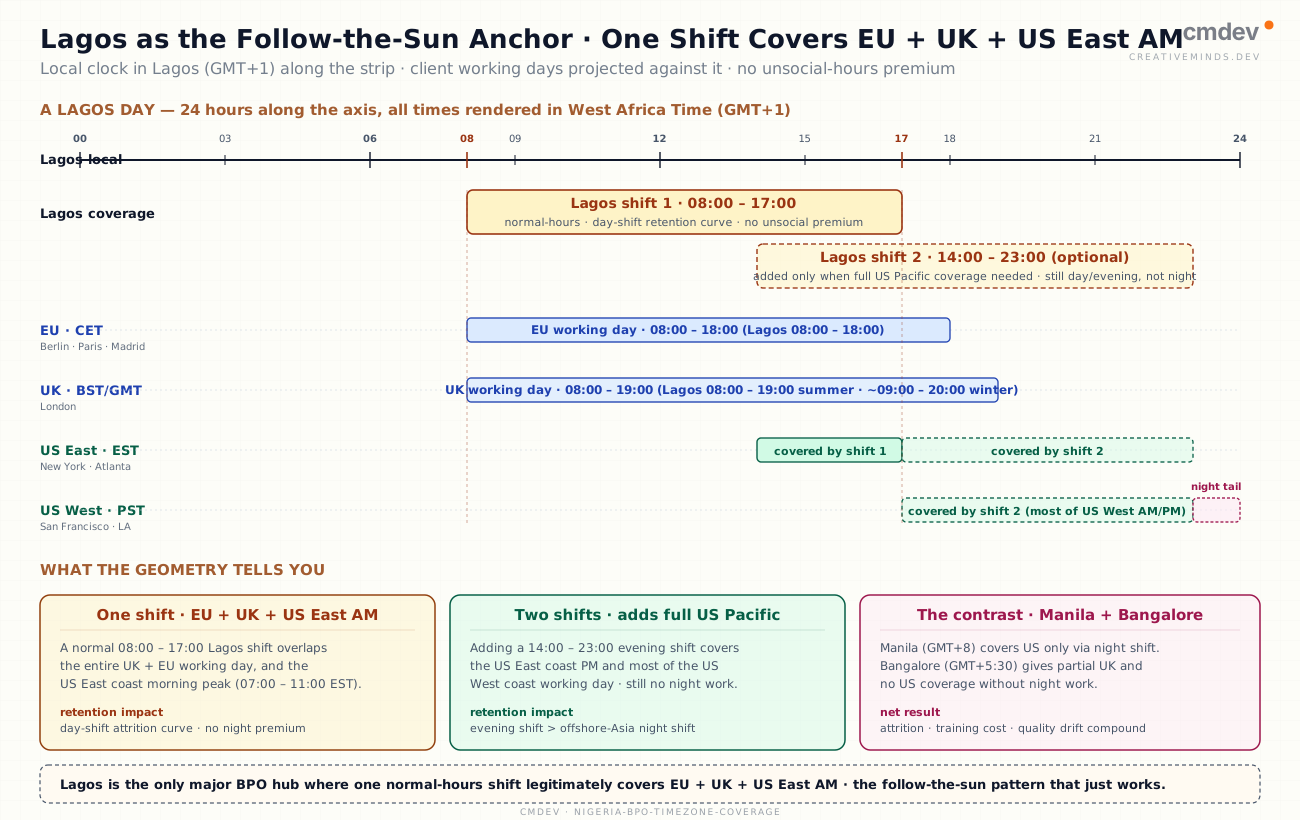
Nigeria sits on West Africa Time, GMT+1. That single fact is more strategically valuable than most procurement teams realise, the way a single road junction in a small town can quietly decide which side of the country trade flows through for a century.
A Lagos shift starting at 08:00 local overlaps the entire UK working day and the full Western and Central European day with no unsocial-hours premium. The second half of the same shift overlaps the US East coast morning, the window when most US-facing inbound volume arrives. One normal-hours shift covers the European day plus the first half of the US East coast day. No night work. No retention penalty on the operators.
Compare the alternatives at the same intersection. Manila on GMT+8 only overlaps the US working day by running a night shift that erodes retention quietly and steadily. Bangalore on GMT+5:30 gives partial UK coverage and no US coverage without night work. Cape Town is geographically close to Nigeria but draws from a much smaller graduate base. The follow-the-sun pattern is genuinely cheaper when one of its nodes does not require its operators to live upside-down. Lagos is that node.
The Cables That Quietly Changed the Map
For most of the 2010s, the honest objection to Nigerian BPO was the internet path. Lagos was undersupplied with international bandwidth, round-trip latency to London was inconsistent, and datacentre power was the kind of chronic problem that derailed contracts in week three. That objection has been substantially resolved by infrastructure that landed between 2022 and 2024 the way new motorways land in a country — visible to anyone watching, invisible to procurement leads who looked once in 2018 and never updated their notes.
Three subsea cable systems landed in Lagos across those three years. Equiano, Google's project, came ashore in 2022 with design capacity above 144 Tbps. 2Africa, the Meta-led cable, made its West African landings in 2024, connecting thirty-three countries with branches into Lagos and Port Harcourt. MainOne, now Equinix MainOne, has run the Lagos-to-Lisbon route as a stable second carrier since 2010. Composite capacity reaching Lagos now sits above 200 Tbps. Per-megabit transit costs dropped roughly seventy per cent between 2022 and 2025.
The datacentre layer caught up alongside the cables. Rack Centre is a Tier III facility expanding to 24 MW, hosting the largest concentration of African internet exchange peers and serving as the de facto African internet hub. MDXi provides a second Tier III campus. Equinix LG1 opened in 2024, bringing the carrier-neutral interconnect model into West Africa. AWS has not yet announced a Lagos region, but transit to Cape Town and Frankfurt over the new cable inventory now produces routinely sub-150 ms round-trip latency for Amazon Connect. The production path looks dull on a diagram, which is the point — Lagos operators ride Equiano or 2Africa transit, the Connect endpoint sits in eu-central-1, and the PSTN egress runs on Connect's managed numbers per target market. Boring, working, repeatable.
The Paperwork That Unlocked the EU Conversation
The strongest argument for Nigerian BPO in 2026 is one that did not exist three years ago. The country now has a primary data-protection statute that gives EU and UK clients a defensible legal basis for outsourcing personal-data processing.
The Nigeria Data Protection Act 2023 was signed on 12 June 2023. The General Application and Implementation Directive that operationalised it became effective on 19 September 2025. Together they establish a regime broadly consistent with GDPR — lawful basis, data-subject rights, 72-hour breach notification, DPIA requirements, DPO appointments, and registration with the NDPC. The shape of the law looks familiar to anyone who has read GDPR.
For an EU client outsourcing to a Nigerian provider, the structure is a GDPR Article 28 DPA with Standard Contractual Clauses as the transfer mechanism. The NDPC has not issued an EU adequacy decision, so SCCs remain the operative path — but the alignment is close enough that execution is straightforward, and competent Nigerian processors have templates already in hand. This is exactly the same architecture EU procurement already accepts for the Philippines, India, and Mauritius. For UK clients post-Brexit, the equivalent is an ICO-approved IDTA.
Sector overlays apply where they always have. Financial services BPO touching Nigerian banking customer data falls under the CBN's Cybersecurity Assessment and Testing framework, which is materially aligned with international standards. Insurance data involving Nigerian-resident customers sits jointly under NAICOM and the NDPA. Healthcare BPO for US clients needs explicit architecture — Nigeria has no HIPAA-equivalent statute — so PHI either stays bounded to non-PHI tasks or sits under a Business Associate Agreement, which several Nigerian processors are equipped to execute.
Between 2023 and 2025 Nigeria moved from regulatory ambiguity to GDPR-aligned with executable SCCs. That single transition is what unlocks the EU and UK proposition in 2026.
What AI Augmentation Actually Changes
The old BPO cost argument was a single multiplication: headcount times fully-loaded cost per seat, then pick the lowest number that produced acceptable quality. That arithmetic has stopped describing reality, the way square footage stopped describing the value of city real estate the moment elevators arrived.
A 2026 contact centre running Amazon Connect with Lex bots and Amazon Q for Connect agent-assist deflects roughly thirty to fifty per cent of tier-one volume entirely. Another twenty to thirty per cent is handled with heavy AI assistance where the agent's job is reduced to confirmation. The remaining twenty to fifty per cent is where human judgment actually matters — complex cases, regulated decisions, escalations, emotional handling. The shape is closer to a hospital triage system than to a switchboard.
The operator profile required for that residual work is different from the high-school-leaver-with-a-headset profile that built Manila. Reading and correcting LLM output. Recognising when a knowledge-base answer is wrong. Picking up a multi-turn conversation three exchanges in, where the AI has already started something the human now has to finish well. This is skilled work — closer to a graduate-trainee profile than to a scripted-call profile.
The Nigerian cost shape fits the new profile cleanly. Fully-loaded cost for a graduate-trained Nigerian operator on an AI-augmented seat sits roughly sixty to seventy per cent below the equivalent UK or US in-house cost, and in the same range as a Philippines or India seat not operating in the augmented model. Fewer seats, higher skill per seat, comparable or better unit economics on the total operation.
The pattern from cmdev's Lagos and Abuja operations is consistent across the contracts we run. Total contact-centre headcount drops by forty to sixty per cent versus the pre-AI baseline. Handle time on residual cases rises — the easy cases are gone, and what remains is harder. CSAT holds or improves. Operating cost falls thirty-five to fifty-five per cent. The reduction is not principally from offshore wages; it is from AI deflection plus skilled-operator efficiency. Nigeria is competitive in this model because it produces the operator profile that makes deflection work, not because it is the cheapest labour market on the map.
The Architecture That Settled
The shape of a managed AI BPO operation in 2026 has settled into a four-part pattern, repeatable enough that the deployment is unremarkable engineering.
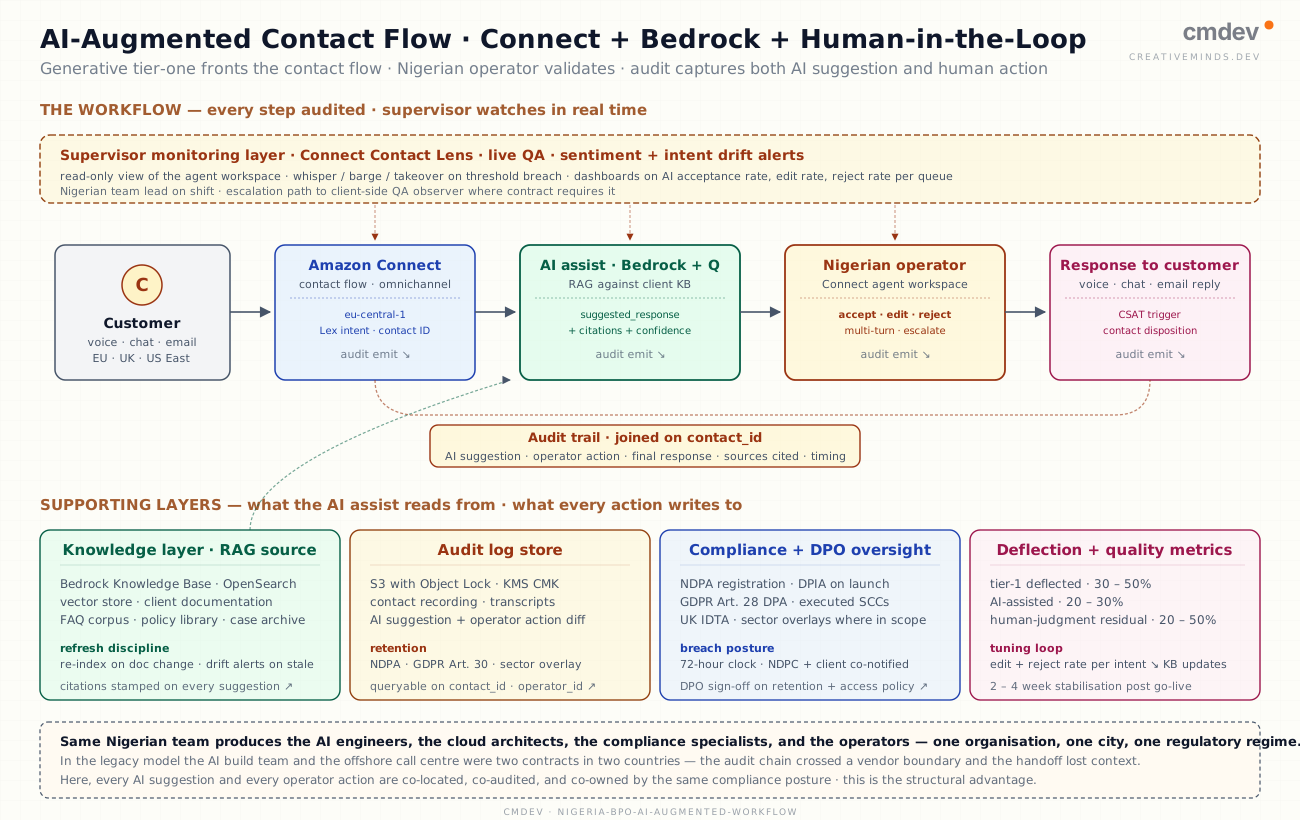
The contact-centre platform is Amazon Connect, handling voice, chat, email, social, and asynchronous messaging as a single omnichannel front end. Telephony numbers sit in the target markets. Recordings land in S3 under NDPA, GDPR, and sector retention rules.
The tier-one AI layer combines Lex bots for structured intent with Amazon Connect AI agents — the generative layer rolled out across 2025 and 2026 — for free-form voice deflection. The generative layer fronts the contact flow, handles structured queries against connected knowledge bases, and escalates to humans on intent or confidence thresholds.
The knowledge layer is a Bedrock Knowledge Base or a vector store fed from the client's documentation, FAQs, policy library, and historical case archive. Retrieval-augmented generation against this layer is what makes the AI agent's responses accurate enough to deflect tier-one volume safely. Take the knowledge layer away and the entire architecture devolves into a chatbot with hallucinations.
The human-in-the-loop layer is the Nigerian operator on a Connect agent workspace with Amazon Q for Connect agent-assist running alongside. The operator sees the customer's history, the AI's interpretation of the conversation, suggested responses with sources, and a one-click escalation path. Their role is to validate, correct, handle the multi-turn case, and exercise judgment on regulated or ambiguous decisions. The AI is the apprentice. The Nigerian operator is the journeyman who signs the work.
Recording, retention, breach detection, DPO oversight, and the audit trail required by GAID, GDPR Article 30, and sector regulators stitch the four layers together. The cmdev engineering practice and the operator layer share the same compliance posture, which matters because the handoff between AI engineering and BPO operations — in the legacy model a contract between an IT vendor and a separate offshore call centre — is now internal to one organisation, one city, one regulatory regime. The same Lagos labour market that produces the AI engineers and cloud architects also produces the operators. Nobody on the bridge speaks a different language to anybody else on the bridge.
Where Nigeria Does Not Fit
This is the section that distinguishes honest analysis from a sales document. Four workloads do not belong in Lagos.
Time-critical US Pacific work is the first. A West Coast company supporting customers across PST will find Nigeria's GMT+1 a stretch on the second half of the day. The Lagos evening covers the US East coast morning well; it is poor coverage for the US West coast morning. Latin American destinations, or hybrid Asia-Latin combinations, work better for that particular geometry.
US Federal and DOD-adjacent work is the second. Anything requiring FedRAMP-equivalent processing, US-citizen-only handling, or FAR and DFARS clauses prescribing on-shore residency rules Nigeria out — and rules the Philippines and India out equally. This is a US Federal procurement constraint, not a Nigerian gap.
Specific US insurance lines are the third. Some state insurance regulators prescribe domestic handling for certain regulated interactions, and it is worth confirming the specific lines before signing a multi-year US insurance back-office contract.
Power-grid exposure is the fourth and most operational. Lagos remains on a national grid that is less reliable than mature markets. Tier III datacentres operate with redundant power, so the infrastructure layer is not exposed. Distributed work-from-home operators are, and need to be designed for — professional providers solve this with mandatory UPS-backed connectivity standards, but it is a real consideration for any new entrant.
Outside those four pockets, Nigeria is the right destination for most US, UK, and EU customer-experience work in 2026 — particularly the work that benefits from AI augmentation. The constraints are knowable up front, the way the depth of a river is knowable before you ford it.
FAQs
Is the time-zone argument really that decisive?
For voice work, yes. One normal-hours Lagos shift covers the UK and EU working days plus the US East coast morning — the highest-volume window for most US-facing inbound. Operator retention in night-shift Asian destinations is materially worse than day-shift Nigerian operations; this shows up in attrition, training cost, and quality consistency. Voice remains the dominant cost line in most contact centres.
What is the realistic deflection rate from AI on the front line?
For structured tier-one queries — order status, balance enquiries, password resets, policy questions answerable from a knowledge base — 30 to 50% is the range we see in production once the bot and knowledge base have been tuned for two to four weeks. Another 20 to 30% gets handled with heavy AI assistance where the human role is confirmation. Financial services and telco deflect more; healthcare and legal less.
How does NDPA compare to GDPR for an EU client?
Close enough substantively that Article 28 DPAs with executed SCCs are the operative path, and competent Nigerian processors have templates ready. NDPC has not issued an adequacy decision for the EU, so SCCs are required — the same position EU clients already accept for processors in the Philippines, India, and Mauritius. For UK clients, ICO-approved IDTAs work the same way.
Will Lagos internet reliably support voice traffic to a Connect instance in Frankfurt?
Yes. Equiano and 2Africa transit produces routinely sub-150 ms RTT Lagos to Frankfurt, well inside the threshold for natural-feeling voice. The infrastructure question that mattered three years ago has been resolved by the cable build-out between 2022 and 2024. Remaining diligence is on last-mile connectivity, which professional providers handle with redundant transit and UPS-backed standards.
What is the right way to pilot a Nigerian BPO engagement?
Start with a single workload — one product line, one channel, one customer segment — and run it for 90 days against a measurable baseline. Define success on three axes: deflection rate, customer satisfaction, and unit economics versus the incumbent. Architect the AI front line and the human handoff together from day one. After 90 days the data tells the story.
Companion content
- NDPA + GAID Compliance Guide — the regulatory base layer for any Nigerian processing engagement
- Production AI Pipelines on AWS Bedrock — the engineering pattern behind the AI-augmented contact centre
- Building AI Agents on Amazon Bedrock Foundations — the agent layer that fronts the contact flow
- The Enterprise AI Playbook — the organisational pattern that makes any AI-augmented operation succeed
- Cloud Infrastructure Management Guide — the managed-services context this work sits inside
How to engage
If you are evaluating an offshore BPO transition for 2026 or 2027, or planning a managed Amazon Connect deployment with AI augmentation, we run that pattern from our Lagos and Abuja operations connected to the cmdev engineering practice. The conversation starts with a 60-minute scoping call to confirm fit on time zone, regulatory regime, and workload class before any commercial discussion. Talk to us at creativeminds.dev/contact.