The Connect tenant is the easy part. Stand up an instance in a region, attach a few flows, point them at a Lambda or two — a confident engineer has a working sandbox by lunchtime. The hard part, the part that quietly decides whether the migration ships on schedule, is the phone numbers themselves. Not the IVR. Not the agent desktop. The DIDs your customers dial. The toll-free your marketing printed on six million envelopes last Christmas. The vanity number the CEO has answered personally since 2003.
AWS publishes two pages on the subject — one on porting, one on claiming. Both pages are accurate. Neither tells you what the carrier handoff actually looks like in week eight, when the FOC date slips, the Letter of Authorisation gets bounced for a comma in the billing address, and the cutover weekend you reserved six weeks ago turns out to be the same weekend the losing carrier's porting desk takes a public holiday in a country none of your team has ever set foot in.
This is what we have learned shipping these migrations across the US, the UK, three EU countries, and Nigeria — and what we wish someone had handed us before we shipped the first one.
Key takeaways
- Porting timelines are set by the losing carrier and the regulator, not by AWS — budget six to twelve weeks per region and start the LOA the day you sign the Connect contract.
- The Letter of Authorisation is the most-failed artefact in the migration — addresses must match the losing carrier's billing record character-for-character, and a comma or company-suffix mismatch resets the clock.
- Regional regulators behave very differently — UK Ofcom is the cleanest, Germany's BNetzA and France's ARCEP have country-specific paperwork AWS support cannot file for you, Nigeria's NCC framework is uneven across carriers in practice.
- The SIP-trunk-plus-claimed-number pattern is the right answer when porting is high-risk — keep the legacy carrier as the SBC-fronted origin and port the numbers as a clean second step once Connect is proven.
- The 72-hour rollback window after cutover is undocumented and load-bearing — losing carriers will accept a port-back if you act fast, and the window is measured in days.
The Box on the Gantt Chart That Eats the Project
Every Connect migration plan we have inherited has the same shape. A Gantt chart with six neatly painted swimlanes — tenant build, IVR, CRM, agent desktop, reporting, training — and a seventh narrow box, somewhere in the middle, labelled "port numbers (2 weeks)." That little box is where the project goes to die.
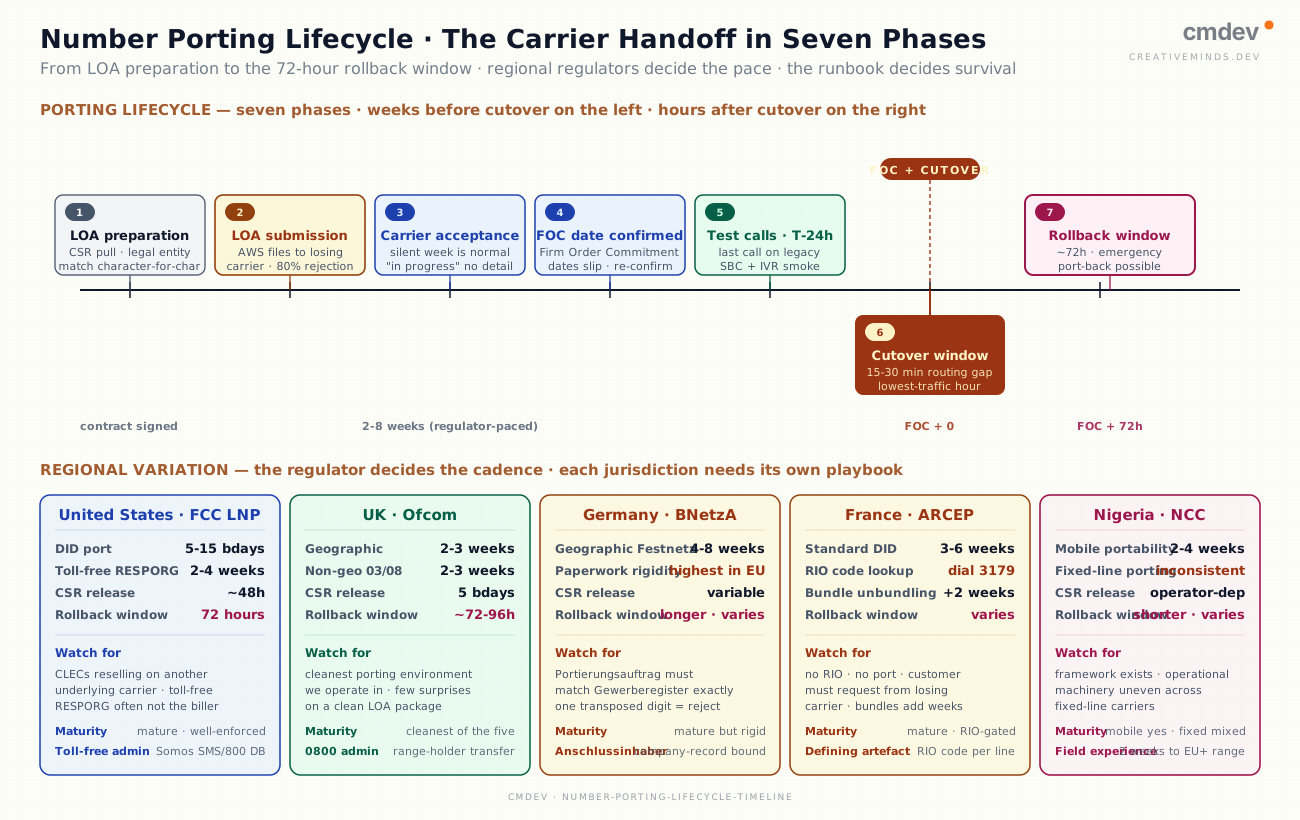
Numbers do not port in two weeks. A best-case US port of a clean DID block runs fifteen business days from a clean LOA to the Firm Order Commitment date. A toll-free RESPORG change is twenty to thirty. A German Festnetz number leaving Deutsche Telekom takes the longest portable timeline the regulator allows. The EU average sits between four and eight weeks. The UK runs two to three. Nigeria is officially fast and operationally inconsistent — we have seen ports clear in under two weeks and we have seen them outlast the EU.
The carrier handoff is the unmovable rock in the migration. You cannot parallelise it by adding engineers, the way you can parallelise IVR work. One losing carrier. One porting desk. One regulator gating the FOC date. The clock starts the day you sign the Connect contract, not the day you finish the agent desktop. Teams that learn this in week one ship on time. Teams that learn it in week eight do not.
The Five Acts of a Port
Every port follows the same shape, the way every river runs from spring to delta. The names change by jurisdiction. The acts do not.
The first act is the Customer Service Record pull. Before any paperwork is filed, you need an authoritative record of how the losing carrier has the account on file — account number, billing address character-for-character, authorised contact, every DID on the account. US carriers release the CSR inside forty-eight hours. The UK takes five working days. The EU varies. Nigeria is operator-dependent. Whatever the CSR says, the LOA must match exactly.
The second act is the Letter of Authorisation itself. A signed instruction from the legal entity that owns the number, mirroring the CSR with surgical precision. Company name with the correct suffix — Ltd versus Limited matters in ways that look comical until you lose two weeks to it. Address character-for-character. Account number in the losing carrier's format. A wet signature from a person actually named on the CSR. Eighty per cent of the port rejections we have seen were LOA defects, and most of those were address-format mismatches.
The third act is the porting request and the FOC date. AWS submits to the losing carrier. The losing carrier responds with a Firm Order Commitment — the moment the number actually moves. US is seven to ten business days out. EU and UK is two to four weeks. FOC dates slip. Carriers reject with a fault code that maps to "we need more paperwork" but, read between the lines, says "we do not want to lose this account." Every rejection resets the clock.
The fourth act is the test-call window. The hour before FOC is your last test on the legacy carrier. The hour after is your first on the new one. Between them sits a fifteen-to-thirty-minute interval where inbound may route unpredictably. Schedule that interval for the lowest-traffic hour you can defend in a meeting.
The fifth act is the rollback path. The losing carrier holds your old configuration for a short window after the port completes, during which an emergency port-back is possible. This is the single most important fact in this article and the one nobody writes down. Plan for it before cutover, not after.
Each Regulator Wears a Different Uniform
Each jurisdiction we ship into behaves like a different country at the airport. Same boarding pass, very different queue.
The United States runs FCC Local Number Portability. Mature, well-enforced, fast on the standard DID port. Toll-free numbers move through Somos under a separate RESPORG workflow — different form, different timeline. The trap is ports leaving competitive local exchange carriers, where the underlying provider may be a different entity again.
The United Kingdom under Ofcom is the cleanest porting environment we have worked in. Geographic and non-geographic 03/08 numbers port reliably in two to three weeks. The paperwork is sane. The desks answer.
Germany under BNetzA is the most rigid we have ever filed paperwork into. Every field on the Portierungsauftrag is checked. The Anschlussinhaber name must match the Gewerberegister entry exactly. A single transposed digit on the customer number triggers automatic rejection. Four to eight weeks, minimum.
France under ARCEP runs on the Relevé d'Identité Opérateur — the RIO code. Every line has one. The customer requests it from the losing carrier by dialling 3179. No RIO, no port. Three to six weeks. Watch for bundled offers that have to be unbundled first, which is itself a separate two-week process.
Nigeria under the NCC has mobile portability that works reasonably across the four major operators. Fixed-line portability is structurally available but operationally uneven — the framework exists, the porting-desk muscle at some carriers does not.
A multi-region migration cannot run on a single porting playbook. Each jurisdiction needs its own LOA template, its own checklist, and a person who knows the carrier-side culture rather than just the regulator-side rules.
Toll-Free Numbers Live in a Separate Universe
US toll-free numbers are not really phone numbers in the same sense as DIDs. They are routing records administered by Responsible Organisations registered with Somos, the entity that runs the SMS/800 database. Moving a toll-free to Connect is a RESPORG change — different form, different timeline of two to four weeks, different failure modes.
The trap that catches most migrations is that the enterprise does not actually know who its current RESPORG is. Toll-free numbers acquired through resellers, marketing agencies, or long-merged subsidiaries are often held under a RESPORG that is not the carrier sending the invoice. We once spent a week tracing a number back to a defunct agency whose former principal had to be located before the transfer could be authorised. The same shape applies in the UK for 0800 numbers and across the EU's freephone equivalents. Find the entity that controls the routing record, not the one that sends the invoice. A Somos lookup is the first phone call.
The Third Option AWS Never Pitches
The Connect documentation presents the choice as binary — port your numbers in, or claim new ones from AWS. There is a third option, and it is the right answer more often than either of the first two.
Keep your legacy carrier. Claim new numbers in Connect. Bridge the legacy numbers into Connect over SIP. The legacy carrier terminates inbound calls on a Session Border Controller you control. The SBC originates a SIP call to a Connect SIP endpoint — Amazon Chime Voice Connector is the standard pattern. Connect handles the call as if the number were claimed natively. The CRM, IVR, and agent desktop never know the difference.
This is the right answer when porting is high-risk: vanity numbers, toll-free with active marketing dependencies, regulated lines, region-by-region migrations where you want hybrid sequencing, legacy carriers with bundled services that prevent a clean exit, or jurisdictions where the losing carrier is slow.
The trade-offs are honest. You pay two carriers. You operate an SBC. The latency budget gains one extra SIP hop. What you buy in exchange is decoupling — you prove Connect with low-risk numbers, port at your own pace, and always have a clean rollback because the legacy carrier never went anywhere.
The Seventy-Two Hours Nobody Counts
After a port completes, the losing carrier holds the original routing configuration for a short window — seventy-two hours in the US, longer in some EU jurisdictions, sometimes shorter in Nigeria. During that window an emergency port-back is possible. After the window closes, a port-back becomes a fresh port in the other direction, with full timelines, full paperwork, and full pain.
The window matters because Connect cutovers fail in ways that are not visible immediately. The number ports. Test calls succeed. Three hours of production look fine. Then a Friday-afternoon surge surfaces an IVR routing bug, an SBC certificate expiry, a Lambda permission that worked in test and quietly does not work in production. Now the team faces a choice. Fix forward under pressure on a contact centre that is offline. Or roll back while the option still exists.
If the team has planned the rollback, it looks like this. An emergency LOA pre-filled with the original details, awaiting only a signature. A verified contact at the losing carrier's porting desk, with their emergency port-back process written down in advance. A decision criterion in the runbook that distinguishes rollback from fix-forward. A named human empowered to call it — not a committee, not a Slack thread, a person.
If the team has not planned the rollback, the window passes while they debug. We have seen this twice. Both times the team afterwards said the same thing: "We did not know we had that little time."
The Failure Modes That Recur
The vanity-number conflict. Mid-port, marketing discovers a print campaign three weeks out using the number in flight. The carrier cannot pause without re-filing. The clean resolution is the SIP-trunk fallback applied retroactively — legacy holds inbound until the campaign closes, then the port completes on the next available window.
The carrier holiday calendar. Most losing carriers run one porting-desk team observing their local public holidays. A cutover scheduled for the Friday before a four-day public holiday in the losing carrier's country lands the FOC on a day with no human cover. A test-call failure on that Friday becomes unrecoverable for four days.
The porting black hole. Between LOA acceptance and FOC confirmation, status from the losing carrier is opaque. Connect's porting page shows "in progress" with no detail for days at a time. This is normal. The silent week is the normal week.
The half-ported number. The losing carrier completes the port in their systems. The gaining carrier completes it in theirs. Somewhere between them, a routing record in a third-party transit network is wrong. The number rings on neither side. Fixing it requires both carriers to coordinate through the transit network — typically one to three business days while the contact centre operates without that line.
The LOA that fails on Ltd versus Limited. A real example: the CSR showed "Acme UK Limited," the LOA showed "Acme UK Ltd," and the port was rejected with a code that eventually mapped to "company-name mismatch." Two weeks lost on a single missing word.
The Runbook AWS Did Not Write
Seven days out, the CSR and LOA are reconciled and signed off by the legal-entity contact. The FOC is confirmed. The cutover window is booked with operations. The rollback LOA is pre-filled. The losing carrier's emergency porting-desk contact has been verified by phone. The SBC has been tested if SIP fallback is in scope.
Twenty-four hours out, a final test call goes through on the legacy carrier. The operations lead walks through the Connect flow live. CRM smoke tests run. Lambda permissions are verified in production, not just in staging. The porting desk is called one more time to confirm a human is on duty during the window.
Inside the cutover window, a named person sits on the bridge with a stopwatch. A test phone with a SIM from a different carrier is used so you are testing inbound from a true external network, not from your own. Success criteria are explicit: ringback, IVR audio, agent answer, hangup tone. Failure criteria are explicit, and so is the named decision-maker for rollback. Inbound volume is monitored actively so a drop is visible before customers complain.
Two hours after cutover, test calls run every fifteen minutes. From hour two to hour eight, every hour. Reporting between the legacy ACD's final hour and Connect's first hour is reconciled by a human.
Seventy-two hours after cutover, the rollback window closes. If the migration is clean, you have shipped. If you failed forward into something you cannot fix in that window, every subsequent decision becomes an order of magnitude more expensive.
A Connect migration is two engagements pretending to be one. The first is a cloud build — tenant, flows, integrations, agent desktop. AWS is the right vendor for that build. The second is a telecoms project — carrier handoffs, regulatory paperwork, FOC dates, rollback windows. AWS is only one of the parties in the second project, and not the gating one. The losing carrier gates. The regulator gates. Your legal-entity records gate. Your runbook gates.
The Connect tenant gets the headlines on launch day. The numbers carry the calls every day after.
FAQs
How long does it actually take to port a number into Amazon Connect?
The Connect-side workflow is days. The carrier-side timeline runs from two weeks in the UK to four to eight weeks in Germany and France, with US ports typically landing in five to fifteen business days. Toll-free RESPORG transfers in the US run two to four weeks. Nigeria varies. The right rule of thumb is six to twelve weeks per region, end to end.
Why does the Letter of Authorisation keep getting rejected?
Eighty per cent of LOA rejections we have seen are character-for-character mismatches against the losing carrier's Customer Service Record — wrong company suffix (Ltd versus Limited), address punctuation, account number formatted differently, or a signature from someone not on the CSR. The fix is to pull the CSR first and copy every field verbatim into the LOA.
When should we use a SIP trunk into Connect instead of porting the numbers?
Use the SIP-trunk-plus-claimed-number pattern when porting is high-risk — vanity numbers, toll-free with revenue dependencies, regulated lines, or jurisdictions with slow porting. The cost is paying both carriers and operating an SBC. The benefit is decoupling — you prove the platform, port at your own pace, and always have a clean rollback.
What is the rollback window after a port completes, and how do we use it?
Most losing carriers will accept an emergency port-back for around seventy-two hours after the port completes, longer in some EU jurisdictions. To use it you need a pre-filled rollback LOA, a verified contact for the losing carrier's porting desk, a documented decision criterion for rollback versus fix-forward, and a named human empowered to call it. After the window closes, a port-back becomes a fresh port with full timelines.
How do toll-free numbers differ from regular DIDs in a Connect migration?
US toll-free numbers are administered by Responsible Organisations via the Somos SMS/800 database, not by carriers in the same sense as regular DIDs. Moving a toll-free to Connect is a RESPORG change to AWS's RESPORG. The common surprise is that the current RESPORG is not always the carrier that sends the invoice — toll-free acquired through resellers, agencies, or subsidiaries often has a RESPORG of record nobody on the current team knows about. Start with a Somos lookup.
Companion content
- Legacy Contact Centre to Amazon Connect — Migration Playbook
- Amazon Connect AI Agent: What Ships, What You Build
- Building AI Agents on Amazon Bedrock — Foundations
- Identity-First AWS Migration for Nigerian Banks
- Bedrock Pipeline — Client Case Study
How to engage
If your team is scoping a Connect migration and the carrier-handoff track has not been planned yet, that is the right week to talk to us — before the LOA paperwork starts and the cutover window gets booked. Talk to us at creativeminds.dev/contact.