Imagine walking into a job interview, and before you can shake the receptionist's hand, she demands a crisp five-dollar bill. You hand it over. You walk into the room. The hiring manager left the building three hours ago. The receptionist keeps your fiver. Next interview, same hallway, same toll booth. Same outcome eight times out of ten.
This is not corporate satire. This is Tuesday morning for millions of freelancers on Upwork.
It is Tuesday morning for us, too. We have been on the platform since 2016 — back when Upwork took its cut at the finish line, when the platform won when the freelancer won, when nobody paid until the contract closed. We were there before the inversion. We watched it happen, one quiet pricing change at a time.
In the decade since, our team at CreativeMinds Development has spent thousands of dollars on Connects. Hundreds of proposals. Top-slot auctions. Cover letters polished at midnight. The result: zero contracts. Not a single one.
The maths you are about to read is not theoretical. It is the ledger we lived through. The article you are reading is the one we wish someone had handed us in 2016, before we paid the first toll.
The internet's largest freelance marketplace has, across the last five years, quietly inverted itself. What started as a platform that took a cut of completed work has become a slot machine that takes its cut at the moment you reach for the lever. Upwork is still a legally registered, publicly traded company on the NASDAQ — it is not a scam in the criminal sense. It is something subtler. Its incentive structure has been rebuilt to extract revenue from the act of trying. Freelancer desperation is the raw material; quarterly numbers are the output.
The Mashable investigation in 2025 documented the scam problem at the surface. Reddit and LinkedIn have been carrying the freelancer testimony for years. Upwork's own help-centre articles on scam avoidance read like a confession too long to make in public. We are writing this now because the platform that promised to democratise freelance work has spent half a decade monetising the act of looking for it — and the people paying the toll deserve a clear-eyed receipt.
Key takeaways
- Upwork's business model inverted from taxing freelancer success (commission on completed work) to taxing freelancer attempts (Connects). The risk used to be shared; now it sits entirely on the job seeker.
- Buying 1,000 Connects for $150 buys roughly 33 proposals at modern application costs. At ~20% client view rate, that is 6-7 glances — $21.42 per client view with no interview, no contract, no guarantee anyone reads past the first sentence.
- ~62% of Upwork job posts never result in a hire. Clients can post for free with no verified payment method, no demonstrated intent, no budget confirmation. Ghost listings are the highest-margin revenue line on the platform.
- Proposal boosting is a blind auction — top-slot bids of 50-100+ Connects push the per-application cost to $15-25, with no visibility into competing bids. The mechanism rewards capital, not craft.
- After a decade on the platform, thousands of dollars in Connects, and zero contracts, cmdev cancelled. The exit is not dramatic — it is a reallocation: inbound demand, cold outreach, peer-vetted networks, and getting any single platform below 20% of pipeline.
The Toll Booth That Used to Be a Tip Jar
Once upon a long enough time ago, Upwork sat at the end of every freelance contract like a waiter waiting for a tip. You finished the job, the client paid, the platform took a slice. Everyone won at the same moment. The platform's interests sat squarely beside the freelancer's interests because both parties wanted the same thing: the deal to close.
That model is gone.
Today the toll booth has moved. It now sits at the front gate, the way a fairground attendant collects a coin before letting you near the ride — whether the ride is running or not. The vehicle for the toll is a private currency called Connects, and the price of Connects has been creeping upwards quietly since 2019 the way a thermostat creeps when nobody is watching.
A single Connect costs fifteen cents. That sounds harmless. The maths gets ugly very fast.
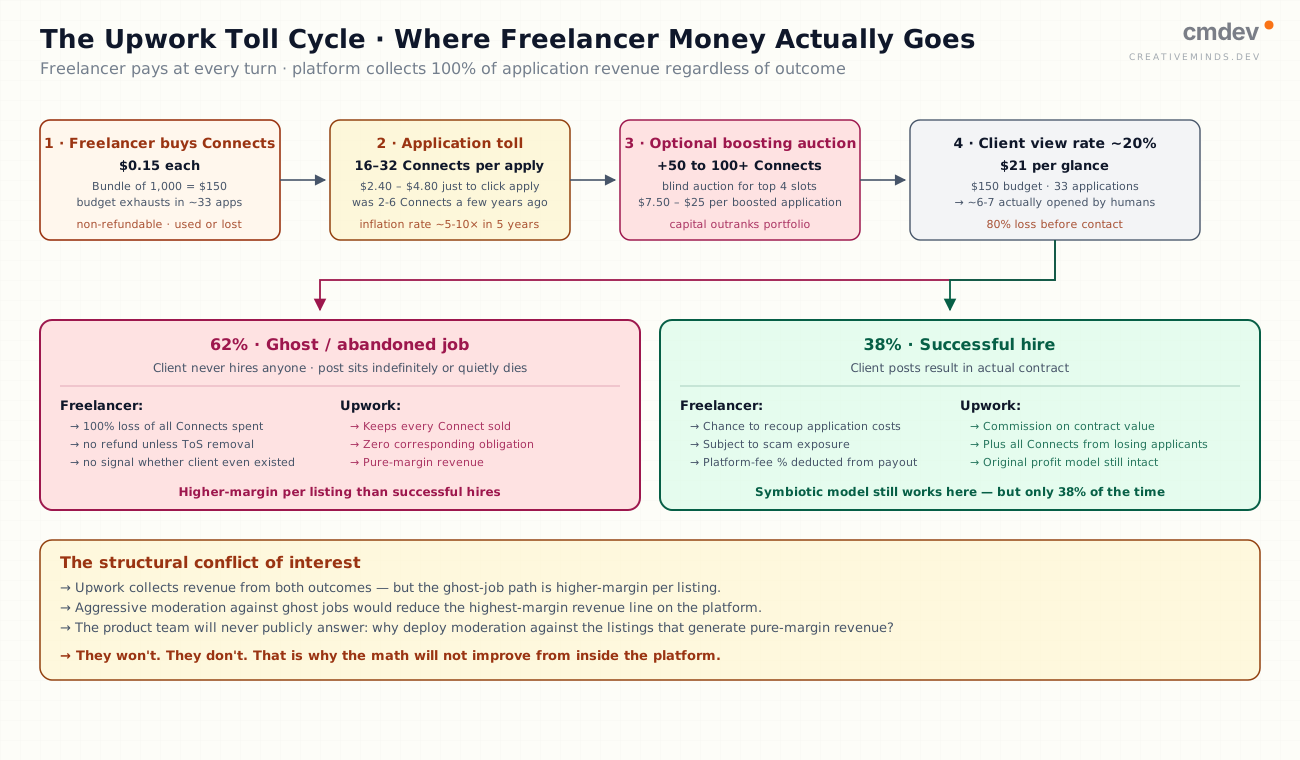
A few years ago, applying to a typical job cost between two and six Connects, or thirty to ninety cents. Today, the same act of clicking "Apply" routinely costs sixteen, twenty-four, or thirty-two Connects. That is between two dollars and forty cents and four dollars and eighty cents per application — before any of the boosting auctions we will get to.
Run the numbers on a standard week. You buy a bundle of one thousand Connects for one hundred and fifty dollars. Applications average around thirty Connects each, which is conservative once you factor in light boosting to stay visible. The bundle stretches to roughly thirty-three proposals. Upwork's own platform data, corroborated by community math, puts the average client view rate at about twenty per cent. Of your thirty-three carefully tailored proposals, six or seven will ever be opened by a human being.
That is one hundred and fifty dollars for six or seven glances. Twenty-one dollars and forty-two cents per client view, with no guarantee that any view leads to a reply, never mind an interview, never mind a contract. The view is the only thing your money buys. Everything that happens — or fails to happen — after the view is outside the transaction.
The risk used to be shared. Now it sits entirely on your side of the table.
The Ghosts Pay the Best
The most exploitative thing about the modern Upwork economy is what the platform does not do when clients abandon their listings.
Posting a job on Upwork is free. The client does not have to verify a payment method, prove intent to hire, or confirm a budget. They click a button, paste in a job description, and the listing goes live. Predictably, the platform is flooded with listings that lead nowhere. Freelancer advocacy data, corroborated by years of community testimony, suggests that only about thirty-eight per cent of jobs on the platform ever result in a hire. The remaining sixty-two per cent are ghost clients — people who abandoned the listing, resolved the problem elsewhere, never had a real budget, were market-testing, or were never serious in the first place.
The financial shape of that sixty-two per cent is the part worth staring at.
| Job Post Outcome | Probability | Freelancer | Upwork |
|---|---|---|---|
| Successful Hire | ~38% | Chance to recoup application costs through contract | Commission on contract value |
| Ghost / Abandoned | ~62% | 100% loss of all Connects spent — no refund | Keeps every Connect sold, no obligation |
A ghost client who posts a vague or fraudulent listing draws fifty hungry freelancers, each spending up to five dollars on Connects, and generates several hundred dollars of platform revenue against zero work performed. The platform pockets every cent. The official refund policy is explicit: Connects are only refunded if Upwork itself removes a post for violating its terms, or if the client manually closes the job in a specific window. A client who simply walks away and lets the listing rot is a pure-profit event.
The conflict of interest is structural. The platform has no financial incentive to clean up ghost listings, because the ghosts are the highest-margin revenue line on the entire site. Ask Upwork's product team in public why the moderation against ghost jobs is not more aggressive and there is no clean answer they could give. Their incentive is the inverse of the freelancer's. The freelancer wants the dead listings gone. The platform wants them up just long enough to collect another fifty applications.
The Auction That Buries Talent
If the base application fee is the entry toll, Proposal Boosting is the engine for artificial price inflation. Upwork describes it as giving freelancers more control over visibility. It is, in plain language, a real-time blind auction running in a black box.
Here is how it operates. A client posts a job. Freelancers apply. Anyone willing to spend extra Connects can bid for one of the four top slots in the client's inbox — the slots the client almost always actually reads. The bidders cannot see what anyone else is bidding. They throw their money into a sealed box, against an invisible crowd of competitors, hoping their bid clears.
A single top-slot proposal commonly costs fifty to a hundred extra Connects on top of the base fee. That puts the price of a single application, in any reasonably popular category, between fifteen and twenty-five dollars.
This is where the meritocratic premise of the platform shatters. The portfolio you spent five years building cannot outbid an agency with a corporate credit card it does not care about reloading. Automated bidding bots, well-capitalised agencies, and offshore farms with high-volume operations consistently outbid independents. Talent, portfolio depth, tailored cover letters — all rendered irrelevant if your proposal is three pages deep behind better-funded competitors. The mechanism is functionally identical to programmatic ad auctions, except the participants are independent workers betting grocery money for a chance at an interview slot.
A platform that calls itself a marketplace for skilled professionals has, in practice, built a system where the ability to pay outranks the ability to do the work.
Paying to Get Scammed
There is one more cruelty in the structure. The toll booth applies even when the client on the other side is not real.
Because Upwork allows anyone to post a job for free with no verified payment method, the platform is a hunting ground. Freelancers face what is best called double jeopardy — they spend non-refundable Connects to apply to a listing that turns out to be a documented fraud operation. The patterns are well-known. The off-platform bait-and-switch lures freelancers onto Telegram, Signal, or WhatsApp, where the scammer pivots into identity theft or fraudulent cheque-cashing. The PDF malware trap disguises a project brief as an ordinary attachment and infects the endpoint with info-stealing malware the moment it opens. The free-trial exploitation collects twenty to fifty unpaid sample articles, sample designs, or sample code, then deletes the listing and walks away with crowdsourced labour. The fake-payment-verification scam sends a forged deposit confirmation and asks the freelancer to wire back a "processing fee" — when the deposit bounces, the wire is gone.
Mashable's 2025 investigation documented exactly these patterns. Upwork's own scam-avoidance help pages read as an inadvertent admission that the problem is endemic. The moderation remains reactive — listings get flagged after freelancers lose money, removed after the scammers have collected what they came for, and the Connects spent are not refunded unless someone makes enough noise on social media to force the issue.
There is a defensible argument that no marketplace can perfectly vet every client at Upwork's volume. There is no defensible argument for charging freelancers in advance to apply to listings the platform has not vetted at all. Free-to-post and pay-to-apply is exactly backwards from how every legitimate marketplace in history has operated.
How to Walk Away
Upwork is the cautionary tale for the gig economy. What started as a platform meant to democratise freelance work has become a closed, extractive ecosystem that thrives when its users fail.
If you are a freelancer reading this, the hard part of the truth is simple. The platform is not on your side, and the maths will not improve from here. Quarterly earnings depend on Connects revenue. Connects revenue depends on application volume. Application volume depends on freelancer hope. Every product decision Upwork makes from this point on is shaped by that chain. There is no future quarter where Upwork voluntarily makes Connects cheaper, ghost listings rarer, or auctions less aggressive.
The exit is not a single dramatic move. It is a compounding reallocation, the way a small portfolio shift over five years quietly rotates an entire retirement account into different assets.
Stop buying Connects to apply to abandoned jobs. Set a strict monthly Connects budget well below what the platform's pricing tries to anchor you at. Treat every Connects purchase as a tracked marketing expense, not as a baseline cost of doing business. If your Connect-to-hire ratio is worse than one in fifty, you are losing money on every visit to the site.
Spend the hours you used to spend on applications building inbound demand instead. A self-owned portfolio site ranking for the work you do is the long compound interest in this story. A technical article, a published case study, a clear explanation of a hard problem — these are the artefacts that attract clients without any Connects in between. The client who reads your essay and writes to you cold is twice as qualified by the time they say hello.
Do direct outreach. Ten well-researched cold emails to specific decision-makers per week, with subject lines grounded in real context, will outperform fifty Upwork applications on conversion rate. LinkedIn messages to hiring managers at companies that match your skill set beat the Upwork auction by orders of magnitude on return.
Use peer-vetted networks. Polywork, Contra, Toptal — with its own flaws but not the Connects economics — and increasingly specialist Slack and Discord communities offer work without the toll booth. Vertical, industry-specific networks consistently beat horizontal marketplaces on quality.
Diversify until no single platform sits above twenty per cent of pipeline. If eighty per cent of your income comes from one platform, that platform owns you, and the pricing reflects it.
The freelancers who will thrive across the next five years are not the ones who outbid the auction. They are the ones who pulled their money out of the auction house and built tables of their own.
FAQs
Is Upwork a scam?
Not in the criminal sense. Upwork is a legally registered, publicly traded company on NASDAQ. But its economic structure — free-to-post listings, pay-to-apply Connects, blind-auction boosting, no refund for ghost listings — converts freelancer desperation into platform revenue with no corresponding obligation to deliver actual work. The structure is the problem; the legality is not the question.
What is the actual cost per client view on Upwork in 2026?
About $21.42 per client view at a 20% view rate, working from a $150 bundle of 1,000 Connects, with applications costing roughly 30 Connects each. That figure assumes light boosting and conservative application costs; competitive categories with aggressive boosting can push the per-view cost much higher.
What does Upwork do when a client abandons a job posting?
Keeps every Connect spent. Refunds only happen when Upwork itself removes a post for violating Terms of Service or when the client manually closes the job within a specific window. A client who simply walks away and leaves the post sitting indefinitely is a pure-profit event for the platform — no work performed, no value delivered, every applicant's spend retained.
Why is proposal boosting a blind auction problematic?
Freelancers cannot see what others are bidding. They bid into a black box, against an invisible crowd, with their own money. The mechanism is structurally identical to programmatic ad auctions — except the participants are independent workers betting grocery money for an interview slot. Talent and portfolio depth lose to whoever has the credit card capacity to over-bid.
What replaces Upwork for a freelancer trying to exit?
A compounding reallocation, not a single switch. Inbound demand through a self-owned portfolio that ranks for the work you do. Direct cold outreach to ten specific decision-makers per week. Peer-vetted networks — Polywork, Contra, vertical Slack and Discord communities. Hard diversification until no single platform is more than 20% of pipeline. The freelancers who thrive over the next five years are the ones who pulled their money out of the auction house.
We cancelled our Upwork account today.
After a decade of buying Connects, paying into auctions, and watching our money disappear into ghost listings — we walked away. This article is the receipt. It is also the last toll we will pay.
Mayowa A. is CTO of CreativeMinds Development. CreativeMinds Development (cmdev) builds production AI for regulated enterprises across the US, Africa, and the EU.