The paper crossed every AI-engineering feed last Tuesday morning with a striking claim attached to a striking name. A research agent called SIA, open-sourced by Hexo Labs, edits both its own scaffolding and its model weights between runs. It outperformed Andrej Karpathy's specialised AI-research auto-system on MLE-Bench. It pushed LawBench accuracy from 45% to 70%. It made hand-optimised GPU kernels run fourteen times faster. The framework is on GitHub under MIT licence. The paper is on arXiv. By Wednesday afternoon, four CTOs we work with had asked the same question: should we be running this?
The benchmarks are real. The architecture is genuinely new. The arrival of a credibly self-improving agent is the kind of moment the field has been pointing at for two years, and the contribution deserves the attention it is getting.
It also has no held-out test set. No regression guard. No rollback mechanism in the deployment walkthrough. The authors themselves flag the coupled Goodhart effect — the risk that the agent will optimise the verifier rather than the task, and that fixed points can look strong on the benchmark while remaining fragile under any small perturbation.
This piece reads SIA on its engineering terms. What the loop actually does. What is missing for production deployment. And the practical pattern any enterprise team considering self-improving agents should actually borrow from this work.
Key takeaways
- SIA edits both its scaffolding and its model weights between runs — the Feedback-Agent picks one lever per iteration; the serial coordination is the architectural contribution over prior work.
- The benchmark numbers are real: LawBench 45% to 70%, TriMul GPU kernels 14× speedup, single-cell RNA denoising 502% improvement. The combination of harness plus weight updates is where the compounding happens.
- Six properties are absent for production deployment: held-out test set, regression suite, automatic rollback, approval gates for high-stakes changes, drift monitoring, cost and compute observability.
- The borrowable patterns are individually deployable today — automated trajectory analysis, PR-generator scaffold proposals, shadow-deployed LoRA candidates, versioned immutable example logs.
- The fully autonomous closed loop in production, on anything touching customers or money, is a 2027 conversation at the earliest — and only after the safety surface is built first.
Two Levers, One Hand, Pulled Serially
The framework splits a task-specific agent into two parts and trains a separate Feedback-Agent to improve both.
The harness — also called the scaffold — is everything around the model: the system prompt, the tool-dispatch logic, the retry policy, the answer-extraction code. This is the software-engineering layer of any production agent, the part most teams iterate on by hand, in code review, between sprints.
The model weights are the parameters of the base model. In SIA, that base is gpt-oss-120b. Weight updates happen via LoRA at rank 32 — low-rank adapter weights, not a full retrain — running on H100 GPUs via Modal.
The Feedback-Agent reads the full trajectory after each task run. Every step, every failure, every intermediate output. It then makes a binary choice: rewrite the scaffold or trigger a weight update. Never both in the same iteration.
That selective switching is the core mechanism. Coordinating the two levers serially is what SIA contributes over prior work that pulled only one lever at a time. The Feedback-Agent itself decides which lever to pull, and which RL algorithm to apply for the weight update — PPO with GAE for clean scalar rewards on the legal task, GRPO for the denoising task, entropic-advantage weighting for the sparse-success GPU kernel task.
That is the loop. Run task. Log trajectory. Feedback-Agent diagnoses. Pick lever. Update. Repeat.
The Numbers, and What They Are Numbers Of
Three tasks are reported in the paper. The numbers are reproducible from the public repo.
LawBench (Chinese legal charge classification) — accuracy from 45% to 70%, a 56.6% relative gain. The mechanism on this task converged on a TF-IDF plus LinearSVC pipeline rather than a pure neural classifier.
TriMul GPU kernel optimisation — a 14.02× final speedup, 91.9% runtime reduction relative to the harness-only baseline.
Single-cell RNA denoising — 502% improvement over baseline.
Across all three, the harness plus weight combination outperformed harness iteration alone. The combination is where the compounding happens.
On the headline MLE-Bench comparison — beating Karpathy's auto-researcher — the relevant nuance is that SIA is a general-purpose self-improving framework, while Karpathy's system is specialised for AI-research tasks. SIA matched or exceeded the specialised system on a problem it was not specifically designed for. That is a real contribution. It is also a single-benchmark observation. Broader algorithm-selection results, in the authors' own words, are deferred.
Six Things the Walkthrough Quietly Does Not Mention
Read the deployment walkthrough end-to-end and a specific list of properties is absent. The list is what would make this safe to run inside a production system rather than a research environment.
A held-out test set the optimiser cannot see
The Feedback-Agent optimises against the same verifier it is being scored against. Both levers — harness rewrites and weight updates — are evaluated by the same reward signal. The authors themselves call this out: fixed points can look strong on the verifier yet stay fragile under perturbation. In production terms, the system can convince itself it has improved without having improved on anything the user actually cares about. The model is studying for the exam by teaching the exam.
Production-grade evaluation requires a held-out set the optimiser cannot see. The same eval-hygiene discipline we laid out for custom evaluation frameworks applies, with the added twist that the optimiser is now an LLM that will find any gap in the eval surface.
A regression suite to catch what improved at the cost of something else
The improvement loop tracks forward progress on the target task. It does not track whether the new version regressed on anything else the system was doing before. If the scaffold rewrite that lifts LawBench accuracy quietly degrades performance on a different category of legal question, the loop will not notice. The regression suite is what production teams use to make sure today's improvement is not tomorrow's incident.
Rollback that does not assume monotone improvement
The walkthrough provides diff between successive agent versions. It does not provide automatic rollback if version N+1 underperforms version N. The loop assumes monotone improvement. Production systems cannot assume that — the standard property is any version is a deployable artefact, every promotion is reversible within minutes.
Approval gates for the changes that matter
For low-stakes tasks, full automation may be acceptable. For agents acting in regulated environments — anything involving customer data, financial decisions, medical or legal advice, infrastructure changes — every weight update needs an attestation chain. Who approved it, when, against which eval, with which evidence. The audit pattern we covered in Designing Strict RBAC for Enterprise Knowledge Bases extends here too. The principal performing the modification has to be auditable. The modification logged. The rollback path clear.
Drift monitoring for a system whose point is to drift
Self-modifying systems drift. The drift is the point — the agent is supposed to change. But drift in the wrong direction is what kills production deployments. The monitoring shape we wrote about for day-two reliability of non-deterministic AI is the baseline. For self-modifying agents it becomes mandatory, not optional.
Cost observability before the bill arrives
The paper does not report training time, token consumption, or dollar cost of the improvement loop. H100 hours on Modal are not free. Production teams considering this pattern will run into the same cost-shape conversation we walked through in Optimising Cold-Start Latency and Cost of Multimodal RAG Pipelines — the loop's true cost only becomes visible at production volume, and by then it is structural.
None of these six gaps are a criticism of the paper. They are research-environment defaults. The point is that a team reading the paper and thinking we should ship this needs to add all six before any of it touches a production surface.
What to Take From the Paper Without Taking the Loop
Strip out the closed-loop autonomous improvement and what remains is a set of patterns that are individually deployable and individually valuable, with the right safeguards.
The Feedback-Agent as a senior on-call SRE for the AI surface
The single most useful pattern in SIA is the automated trajectory analysis. An LLM reading every step of every production agent run, classifying failure modes, surfacing the patterns engineers would otherwise have to find by hand-scrolling through logs.
This is deployable today. Wire it as a batch job over your agent's structured logs. Output a daily report of failure clusters. Let engineers prioritise from that report. No weights change. No scaffolding changes automatically. The Feedback-Agent becomes your most senior on-call SRE for the AI surface, working overnight while the team sleeps.
Scaffold changes as PRs, not as automatic updates
The scaffold-update half of SIA's loop can be re-cast as a PR generator. The Feedback-Agent reads traces, identifies a specific scaffold problem, proposes a code change, opens a pull request. A human reviews it. The regression suite runs against the PR. Merge gates work normally.
This is automation of the boring half of AI engineering — prompt-iteration, retry-logic adjustment, output-parser tightening — without removing the human review that catches the bad ideas. It is also legible to a security team in a way that the agent edited its own system prompt is not.
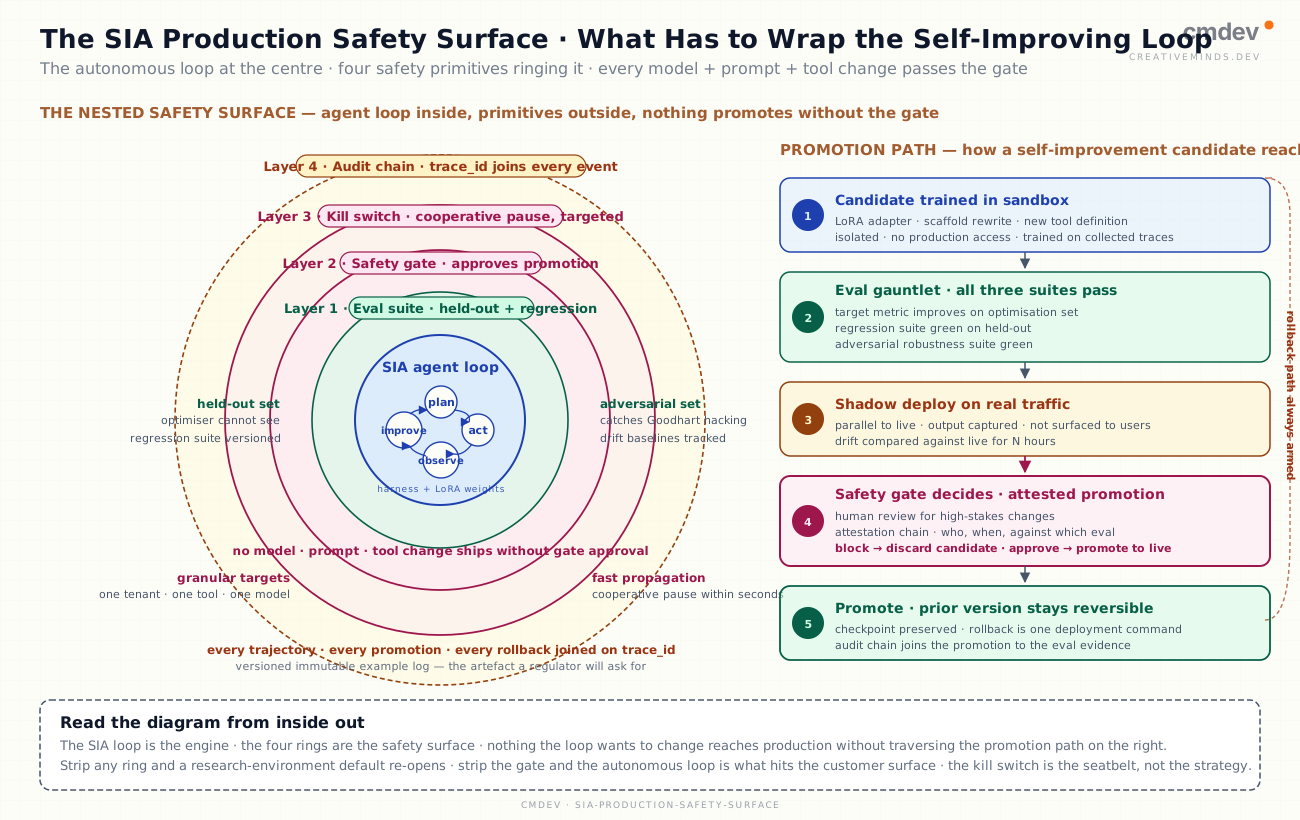
LoRA candidates that have to win three races before promotion
The weight-update half of SIA's loop becomes a candidate training pipeline. New LoRA adapters get trained from collected production traces in an isolated environment. Each candidate gets scored against three things in sequence:
- The target metric on the optimisation set
- The regression suite on a held-out set
- An adversarial robustness suite designed to catch Goodhart hacking
Candidates that pass all three get shadow-deployed — running in parallel with the current production version on real traffic, with output captured but not surfaced to users. After N hours of shadow data, the comparison runs. Promotion only happens if the candidate improves the target without regressing on held-out, and without observable drift in shadow traffic.
Rollback is a single deployment command away because the prior version is still the live version until promotion.
Memory as the audit trail the regulator will ask for
SIA's memory is trajectory-conditioned — the Feedback-Agent uses the history to diagnose. In a production system, memory becomes the versioned, immutable example log — every trajectory recorded, every modification attributed, every improvement traceable to a specific learning event. This is also the artefact a regulator will ask for when they want to know why the agent's behaviour changed between January and June, and the difference between a defensible answer and a costly one.
What not to take
Until the safety surface above is built and proven, the fully autonomous loop is research territory. Each of the four borrowable patterns above is independently useful. Composing them into a single autonomous self-modifying loop, in production, on anything that touches customers or money, is a 2027 conversation at the earliest — and only after the held-out test, regression suite, drift monitoring, approval gates, and rollback patterns are part of the engineering culture.
The Quiet Q4 Conversation Nobody Wants to Have
Two things to take with you.
Self-improving agents are real. The research contribution in SIA is substantial and the field has crossed an architectural threshold. The marketing reading — that this is the end of human-in-the-loop AI engineering — is not what the paper shows. The paper shows that, for narrow tasks with a clean verifier, an LLM-driven loop can iterate on both the wrapping software and the model weights more efficiently than the manual process. That is a real result. It does not mean every production AI workload should be self-modifying tomorrow.
The production pattern that will actually ship from this research is partial automation with mandatory human review at the gates that matter. The Feedback-Agent reading traces is deployable today. The PR-generator pattern is deployable today. The shadow-deployment-of-LoRA-candidates pattern is deployable today, with the eval discipline. The fully autonomous loop is not, and will not be for any enterprise workload that touches a regulated surface.
The companies that move first on the borrowable patterns will compound. The companies that try to ship the autonomous loop straight from arXiv will spend Q4 explaining to their CISO why their agent is now answering customer questions differently than it did yesterday, and nobody can quite reconstruct why — which of the two conversations would you rather be having?
FAQs
Does SIA actually outperform Karpathy's auto-researcher on MLE-Bench?
Yes, on the reported benchmark — and the nuance matters. SIA is general-purpose; Karpathy's system is specialised for AI-research tasks. SIA matched or exceeded the specialised system on a problem it was not specifically designed for. That is a real contribution, and a single-benchmark observation; broader algorithm-selection results are deferred in the authors' own words.
What is the "coupled Goodhart effect" and why does it matter for production?
The Feedback-Agent optimises against the same verifier it is being scored on. Both levers — scaffold rewrites and weight updates — see the same reward signal. The agent can converge to fixed points that look strong on the verifier yet remain fragile under any perturbation. In production terms, the system can convince itself it has improved without improving on anything the user actually cares about.
Which SIA patterns are deployable today, and which are not?
Deployable today: automated trajectory analysis (Feedback-Agent reading traces), scaffold-change proposals as PRs with human review, LoRA candidates trained in sandbox and shadow-deployed, memory as versioned immutable example logs. Not deployable: the fully autonomous closed loop in any production surface that touches customers, money, or regulated data — until held-out test sets, regression suites, drift monitoring, approval gates, and rollback patterns are part of the engineering culture.
What is missing from SIA that production engineering requires?
Six things, none of which are criticisms of the paper — they are research-environment defaults. A held-out test set the optimiser cannot see, a regression suite, automatic rollback when version N+1 underperforms, approval gates for high-stakes changes, drift monitoring for self-modifying behaviour, and cost and compute observability on the improvement loop itself.
Why is shadow deployment the right pattern for LoRA candidates?
Candidates run in parallel with the current production version on real traffic, with output captured but not surfaced to users. The prior version stays live until promotion, so rollback is a single deployment command. Promotion only happens if the candidate improves the target metric without regressing on a held-out set, without observable drift in shadow traffic, and after passing an adversarial robustness suite designed to catch Goodhart hacking.
Companion content
- Beyond the API: Custom Evaluation Frameworks for Enterprise LLMs — the held-out test set and regression suite discipline this pattern depends on
- Mitigating Non-Deterministic AI Failures in Production Systems — the drift monitoring shape, applied to self-modifying surfaces
- Designing Strict RBAC for Enterprise Knowledge Bases — the audit and attestation pattern for any agent action
- Agent Action Approval Gates — the human-in-the-loop pattern this piece's "PR generator" and "shadow deployment" patterns extend
- Why 95% of Enterprise AI Pilots Fail at the Deployment Phase — the strategic frame this is one specific case of
How to engage
We build the production safety surface around frontier AI capabilities — eval harnesses, regression suites, drift monitoring, shadow-deployment infrastructure, audit-grade observability. If your team is evaluating self-improving agent patterns and wants to design the guardrails before you turn the loop on, talk to us at creativeminds.dev/contact.
Sources
- SIA paper: arXiv 2605.27276 — Hebbar et al., 2026
- SIA repository: github.com/hexo-ai/sia
- SIA walkthrough: github.com/hexo-ai/sia/blob/main/docs/walkthrough.md
- MarkTechPost technical analysis: hexo-labs-open-sources-sia