The CVE notification lands at 02:14. The on-call engineer reads it twice. Critical severity. A bug in the sandbox runtime your self-improving agent platform depends on. The patch is available, the disclosure window is hours, and the agent is mid-iteration — holding state, generating its own code, scheduled for the next safety-eval gate at 06:00. The traditional vulnerability-response playbook has three steps that every SRE knows in their sleep. Patch the binary. Restart the process. Validate. He opens the runbook and stops reading after the first sentence, because the runbook assumes a system that is not what is running underneath him.
Patching means new runtime semantics, which may invalidate the agent's last self-evaluation. Restarting kills in-flight loops and any state the agent was holding. Validating against the patched runtime means re-running the safety-eval gate, which on a SIA platform is hours of compute, not a smoke test. Each step of the playbook fights the system it is supposed to fix.
The companion piece self-improving agents: the production pattern describes the architecture these systems run on. This piece is its operational counterpart. What does vulnerability response look like when the system being patched is autonomously improving itself? The response pattern below has held up across three real incidents we have triaged in the last nine months.
Key takeaways
- The patch-restart-validate playbook fights a self-improving agent platform on all three steps — patching invalidates the last self-evaluation, restarting kills in-flight state and generated code, validating means re-running an eval gate that takes hours not seconds.
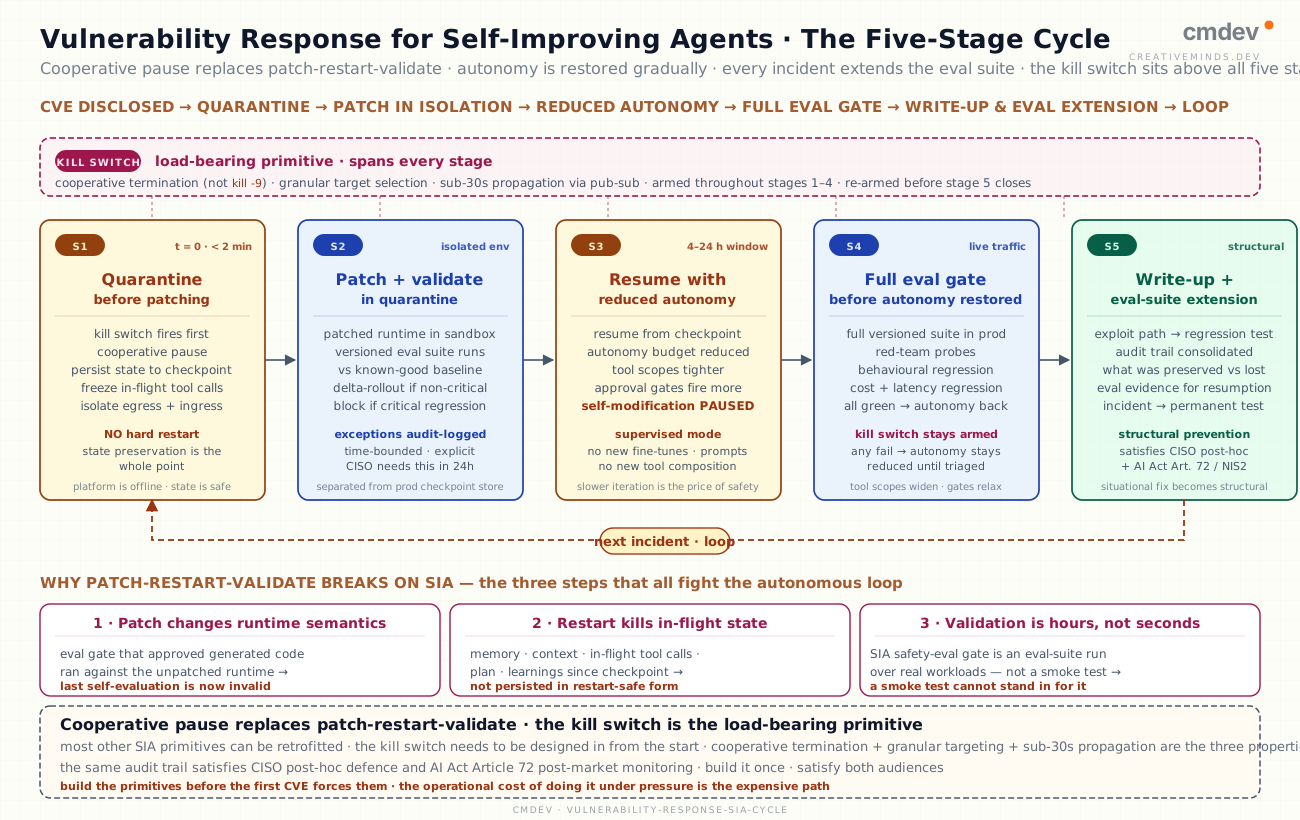
- The five-stage response pattern that works: quarantine before patching (cooperative pause and persist), patch and validate in isolation, resume with reduced autonomy, full eval gate before restoring self-modification, and incident write-up that extends the eval suite.
- The kill switch is the load-bearing primitive — it must support cooperative termination (not kill -9), granular workload targeting, and sub-30-second propagation via pub-sub, not cron polling.
- Reduced-autonomy resumption (tighter tool scopes, more approval gates, no self-modification) typically runs four to twenty-four hours after a patch — the operational cost is the price of safe resumption against an eval suite that might have missed something.
- Every vulnerability response should extend the eval suite with a permanent regression test for the exploitation path, turning situational incidents into structural prevention; the same audit trail satisfies CISO post-hoc defence and AI Act Article 72 post-market monitoring.
Why the Old Runbook Breaks
Standard server vulnerability response assumes the system is stateless or has explicit, durable state. Patch the binary, restart the process, the process picks up from whatever it persisted. For agent platforms this assumption is wrong in four ways.
The agent's state is its memory, its working context, its in-flight tool calls, its plan, its accumulated learnings since the last checkpoint. Most of this is not persisted in a form that survives a process restart. Killing the process loses it.
The agent may be generating its own code — fine-tuned adapters, dynamically composed tool wrappers, prompts that mutate per iteration. A patched runtime may interact differently with that generated code. The evaluation gate that approved the generated code ran against the unpatched runtime. The agreement between system and self-modification is broken at the moment of patch.
The agent's autonomy loop is the surface the vulnerability lives on. An exploited vulnerability in the sandbox could let the agent escape the sandbox. An exploited vulnerability in the MCP server could let an adversary inject tool calls. The window between vulnerability disclosure and your patch deployment is also the window during which an in-flight agent could be exploited.
The audit trail the CISO will need to defend the response decision must capture what state was lost, what was preserved, which iterations were interrupted, and what evaluation evidence supports the post-patch resumption. None of this is in the standard incident-response playbook, and improvising it under pressure produces gaps a regulator will find six months later.
Five Stages, One Loop
The pattern below assumes the SIA architecture from the companion piece: a kill switch, a versioned eval suite, checkpoint-based rollback, principal-of-record audit chain, and a safety surface that gates promotion of model or prompt changes. Without those primitives, the response is much harder and the audit trail much weaker.
Stage one — pause the loop before you touch the runtime
The kill switch fires first. Every agent runtime instance is signalled to pause cooperative work, freeze in-flight tool calls, persist current state to the checkpoint store, and stop accepting new work. This is the difference between a graceful pause and a hard restart. The kill switch must support pause and persist semantics, not just terminate. If your kill switch is kill -9, you have a problem.
The pause must be fast. The window between disclosure and exploitation is the constraint. Two minutes is acceptable, ten is not. Cooperative pause designs win this race. Orchestration-layer broadcast designs lose it.
While agents are pausing, the network surface gets isolated. Tool calls to external systems are blocked at the egress proxy. Inbound traffic to MCP servers is throttled to a known-safe baseline. The agent platform is effectively offline for the duration of the patch window, but its state is preserved.
Stage two — validate the patch against the agent it used to be
The runtime is patched in a quarantined environment, separated from the production checkpoint store and tool surfaces. The patched runtime runs the existing versioned eval suite against a known-good baseline of agent behaviour. This validates that the patch did not break the runtime's contract with the agent's eval-passing code — the prompts, the tool schemas, the model versions that previously passed the safety gate.
If the eval suite regresses on the patched runtime, the response splits. Critical regressions block the patch deployment until the eval failures are triaged. Non-critical regressions get a delta-rollout: the patch ships, but the affected workloads stay on the unpatched runtime in a tightly-contained environment, with explicit time-bounded exception.
The audit trail captures every regression, every triage decision, and every exception. The CISO will need this within twenty-four hours of the patch deployment if anything goes wrong post-patch.
Stage three — let autonomy back in slowly
The patched runtime takes traffic. Agents resume from their checkpoints. The resumption is not a return to full autonomy.
For the first iteration cycle after resumption, the agent runs with the autonomy budget reduced. Tool calls are scoped tighter. Approval gates fire on actions that would normally be auto-approved. Self-modification is paused — no new fine-tunes, no new prompt revisions, no new tool composition. The agent is operationally returned to supervised mode until the eval suite has run a second time against live traffic and confirmed no behavioural regression.
This reduced-autonomy window is typically four to twenty-four hours depending on the workload. The economic cost — slower iteration, more human approval load — is the price of safe resumption. The alternative is to risk a regression that was not caught by the offline eval suite, on a system that improves itself unsupervised.
Stage four — restore the loop, keep the kill switch armed
Once the live-traffic confirmation is complete, the full versioned eval suite runs in production. Red-team probes from the red-teaming discipline test set. Behavioural regression tests. Cost-and-latency regression. If all green, autonomy is restored — the agent can resume self-modification, the approval gates return to normal sensitivity, the tool-call scopes widen.
If any test fails, the patched runtime ships to production but autonomy stays reduced until the failure is triaged. The kill switch remains armed throughout.
Stage five — make the next incident shorter than this one
Every vulnerability response produces at least one new entry in the eval suite. If the vulnerability had a path-of-exploitation that could have affected agent behaviour, that path becomes a permanent regression test. Future patches and future model revisions get tested against the exploitation scenario going forward. The incident becomes structural prevention, not just situational remediation.
The audit trail from stages one through four is consolidated into an incident write-up. What CVE. When disclosed. When the kill switch fired. What state was preserved versus lost. What evaluation evidence supports the resumption. What new regression tests were added. The write-up is the artefact that satisfies the CISO post-hoc and the artefact that satisfies regulatory inquiry if the vulnerability had data-exposure implications.
The One Primitive Worth Designing First
The single highest-leverage piece of the response pattern is the kill switch, because everything else depends on it firing fast and cleanly. Three design properties that we have found necessary in production.
The kill switch must support cooperative termination, not forced termination. The agent runtime listens for kill signals and responds by reaching a checkpoint, persisting state, and exiting. Forced termination loses state, abandons in-flight tool calls in an inconsistent state, and produces an audit trail with gaps. Cooperative termination requires the runtime to be designed for it from the start. Bolting it on later is significantly harder, and we have watched at least two teams discover this at 03:00 on a Sunday morning.
The kill switch must support granular target selection. It must be able to target specific workloads, specific tenants, specific agent versions — not just the whole platform. A vulnerability that only affects agents using a specific sandbox tier should pause only those agents, not the whole estate. Coarse-grained kill switches make the operational decision binary in a way that costs more business continuity than necessary.
The kill switch must propagate fast. The kill signal must reach every runtime instance in under thirty seconds. Pub-sub designs with subscription health checks meet this. Cron-style polling designs do not. The propagation latency is the upper bound on the window during which an exploited vulnerability could be active.
The kill switch is the load-bearing primitive. Most other elements of the SIA architecture can be retrofitted; the kill switch needs to be designed in.
Where This Goes Next
Two trends will reshape the response pattern over the next eighteen months.
Stateful sandboxes with hot patching. Several sandbox runtimes are working on the ability to apply security patches to running instances without process restart. If hot patching matures, the pause-and-persist stage of the response pattern can compress dramatically — patch the running runtime, validate behavioural continuity, resume normal autonomy without the rollback-restart-resume cycle. This is most relevant for sandbox CVEs. Runtime-level CVEs in inference engines or MCP servers will continue to require restart for the foreseeable future.
Standardised agent incident-report formats. Regulatory frameworks are converging on common incident-report shapes for AI systems. EU AI Act post-market monitoring under Article 72 is the most visible. NIS2 incident reporting is the second. The audit-trail pattern that supports these reports is the same pattern that supports CISO post-hoc defence — which is fortunate, because it means the response design can satisfy both audiences with the same evidence.
The Cheap Investment, Done Before the Pressure
The next decade of vulnerability response will look less like patch-restart-validate and more like cooperative-pause, validated-resume, autonomy-modulated-restoration. Self-improving agents are the first workload class to expose this clearly because they hold the most state, generate the most code, and have the largest autonomous blast radius. The same response pattern will, in modified form, apply to any production system with sufficient self-modification surface — and there will be more of those, not fewer.
The teams that have internalised the SIA safety-surface discipline will find that their vulnerability-response process is materially easier than teams who built agentic systems without it. The kill switch, the versioned eval suite, the checkpoint-rollback, the audit chain — these are the operational primitives that turn vulnerability response from an extended incident into a controlled engineering exercise. Building them in advance is the cheap investment. Building them at 02:14 during the incident is the expensive one — and which one are you choosing today?
FAQs
Why can't I just patch, restart, and validate an agent platform like any other service?
Because the agent's state — memory, working context, in-flight tool calls, plan, accumulated learnings since the last checkpoint — is usually not persisted in a form that survives a process restart. Restarting loses it. The patched runtime may also interact differently with code the agent generated against the unpatched runtime, and the window between disclosure and exploitation is also the window during which an in-flight agent could be exploited through the unpatched surface.
What does "cooperative termination" mean for a kill switch?
The agent runtime listens for kill signals and responds by reaching a checkpoint, persisting state to durable storage, and exiting cleanly. Forced termination (kill -9) loses state, abandons tool calls in inconsistent states, and produces an audit trail with gaps. Cooperative termination has to be designed into the runtime from the start; bolting it on later is significantly harder, which is why the kill switch is the load-bearing primitive that needs to be designed in rather than retrofitted.
How long does the reduced-autonomy resumption window need to be?
Typically four to twenty-four hours depending on the workload. During that window, tool call scopes are tighter, approval gates fire on actions that would normally be auto-approved, and self-modification is paused — no new fine-tunes, no new prompt revisions, no new tool composition. The window closes once the full eval suite has run a second time against live traffic and confirmed no behavioural regression.
What is the kill switch propagation latency requirement, and why?
Under thirty seconds to every runtime instance. The propagation latency is the upper bound on the window during which an exploited vulnerability could be active across the estate. Pub-sub designs with subscription health checks meet this requirement; cron-style polling does not. Granular target selection — pause one tenant, one workload class, one sandbox tier — is also necessary so a partial vulnerability does not force a full-estate pause.
Does the audit trail from a vulnerability response satisfy regulatory inquiry?
Increasingly, yes. EU AI Act Article 72 post-market monitoring and NIS2 incident reporting are converging on common incident-report shapes for AI systems. The audit-trail pattern that supports CISO post-hoc defence — what CVE, when disclosed, when the kill switch fired, what state was preserved versus lost, what evaluation evidence supports resumption — is the same pattern that supports regulatory inquiry. Build it once, satisfy both audiences.
Companion content
- Self-Improving Agents: The Production Pattern
- AI Red-Teaming as a Discipline
- Agent Code Execution: MicroVM vs Container
- IAM for AI Agents
- Agent Action Approval Gates
- AI Workload Posture Management
How to engage
If your team is running self-improving agents in production and your vulnerability response playbook is still the patch-restart-validate cycle, we can help you build the cooperative-pause-and-resume discipline before the first CVE forces it. Talk to us at creativeminds.dev/contact.